
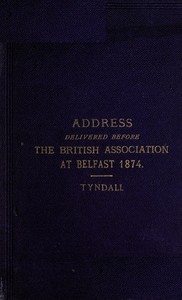
Address delivered before the British Association assembled at Belfast by Tyndall
Imagine the drama: A packed hall, everyone sweaty under Victorian collars, and a man named John Tyndall steps up to the microphone. He is a world-famous physicist—the guy on that exploding mountain (literally). And tonight, he’s about to tell a room full of scientists, clergy, and journalists that their souls are just fancy electricity. That is the vicious, glorious heart of Address delivered before the British Association assembled at Belfast by John Tyndall.
The Story
There’s no plot in the normal sense—thank goodness, because real life is rarely a fairy tale. Tyndall is giving the Presidential Address to the British Association for the Advancement of Science. But instead of being boring, he immediately gets into a fight. He traces the history of science from Democritus (a Greek philosopher who thought everything was made of tiny atoms), through Copernicus, Galileo, and Kepler—each one a “criminal” for being right. Then he goes for the throat: attacking what’s called “materialism” versus the “idealist” thinkers of his time. Tyndall says that matter and force carry all the answers. Yes, everything from love to thinking came out of chemistry and physical particles. No angels here. Then he says two fateful words: “imagination” and “inquiry.” Tyndall claims physicists can imagine everything—origins, life, even consciousness—as products of natural law, not Christian theology. Cue the outraged letters.
Why You Should Read It
Tapping into this book is like eavesdropping on the biggest philosophical showdown of the 1800s. Tyndall is a freaking superb writer—clear as shouting, without pomposity. He’s sneaky too. The nerd-factor is high, but he’s completely unafraid. Themes: The bravery to think alone, and the birth of secular science. His whole argument is, “Evidence is all we have. Bow to the church, and you never ask the next question.” Infuriated, I felt less existential dread because he shows kindness in advancing theory, not dogma, proving that truth opens us up, doesn’t lock us down.
Final Verdict
The book is for people who love a fight. Specifically, fans of evolutionary biology, atheism debates, and intellectual underdog stories. Perfect for history buffs and rational bible-tuggers. Not for those expecting any plot or for believers who prefer unearthly explanation about everything. Bottom line: bite-sized, maddeningly confident, it sparked a Victorian fire. Tyndall received hate mail, but I think he’d have waved it off—a great guy walking down a dangerous cliff so modern science could walk safely below.
The copyright for this book has expired, making it public property. You can copy, modify, and distribute it freely.
Kimberly Jones
1 year agoUnlike many other resources I've purchased before, the logic behind each conclusion is easy to follow and verify. It’s a comprehensive resource that doesn't feel bloated.