
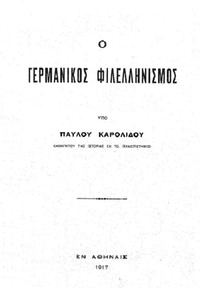
Ο Γερμανικός Φιλελληνισμός by Paulos Karolides
Paulos Karolides' Ο Γερμανικός Φιλελληνισμός is a deep exploration of a surprising historical connection. While many of us learn about the Greek War of Independence through the lens of British or French involvement, Karolides shines a light on a powerful movement much closer to the heart of Europe.
The Story
This isn't a novel with a single plot, but the story it tells is gripping. Karolides traces the birth and growth of German Philhellenism from its roots. He shows how the struggle of modern Greeks against the Ottoman Empire captured the German imagination. The book maps out this support system, which ranged from intellectual circles and university student unions collecting donations, to journalists writing fiery articles, and even volunteers who traveled to fight. Karolides doesn't just list events; he investigates the 'why.' He links the enthusiasm for Greece directly to the political climate in the fragmented German states after the Napoleonic Wars. For many Germans, ancient Greece represented an ideal of freedom, democracy, and cultural purity. Supporting the modern Greeks became a safe way to express their own suppressed desires for national unity and liberal political change at home.
Why You Should Read It
What makes this book special is how it humanizes a historical movement. Karolides helps you see the German Philhellenes not as a vague, noble mass, but as real people with mixed motives. Some were genuine romantics, inspired by a classical education. Others were frustrated politicians and students, using the Greek cause as an outlet for their own revolutionary energy. Reading this, you understand that international solidarity is rarely simple. It's often tangled up with local politics, personal dreams, and the powerful stories we tell ourselves about other cultures. It made me think about how we support causes today and what we might really be searching for when we do.
Final Verdict
This book is perfect for history buffs who enjoy seeing the hidden threads between countries. If you're interested in the Greek War of Independence, 19th-century European politics, or the powerful role of ideas and public opinion in history, you'll find it fascinating. It's also great for anyone who likes a story that challenges the simple 'good guys vs. bad guys' narrative. Be prepared for a detailed, academic-style read—it's not a light novel—but the insights it offers are absolutely worth the effort. You'll never look at European history the same way again.
This title is part of the public domain archive. Distribute this work to help spread literacy.








Barbara Smith
1 year agoI was particularly interested in the case studies mentioned here, the quality of the diagrams and illustrations (if applicable) is top-notch. Definitely a five-star contribution to the field.