
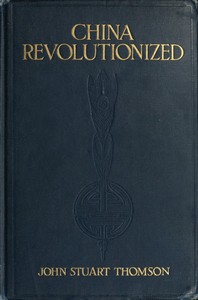
China Revolutionized by John Stuart Thomson
Imagine you're handed a journal from 1913, written by an American who's equal parts engineer, tourist, and worried friend. That's China Revolutionized. John Stuart Thomson lived in China for years, and his book is his attempt to make sense of the colossal shift happening around him.
The Story
There isn't a single character's journey here. The 'story' is China itself. Thomson structures the book like a grand tour. He first walks you through the soul of old China—its philosophy, art, and social customs. You get vivid pictures of daily life, from festivals to farming. Then, the scene shifts. The last emperor has just been overthrown, and the new Republic of China is wobbling on its feet. The second half of the book dives into the 'revolutionized' part: the frantic push for modern railroads, mines, and schools. Thomson reports on it all with the eye of a technician and the heart of someone who genuinely admires the people. The plot is the tension between these two worlds, and the big question hanging over every page: can this ancient civilization adapt without losing itself?
Why You Should Read It
This book grabbed me because it's so personal. This isn't a dry history text. It's filled with Thomson's own observations, his frustrations with Western misunderstandings of China, and his hope for its future. You feel his urgency. He's trying to build a bridge of understanding for Western readers at a time when news was slow and stereotypes were rampant. His descriptions are sometimes dated, sure, but that's what makes it valuable. You're seeing a pivotal moment through the unfiltered lens of a contemporary. It makes the history feel immediate and human, not just a list of dates and battles.
Final Verdict
Perfect for readers who love primary sources and seeing history as it was first reported. If you enjoy travelogues with substance, or if you're fascinated by China's transformation and want a ground-level view from its very first act, this is a rewarding read. Be prepared for the perspective of its time, but read it as the passionate, insightful, and worried document it is—a letter from the edge of a revolution.
This text is dedicated to the public domain. Distribute this work to help spread literacy.
Robert Lee
7 months agoAs a long-time follower of this subject matter, the emphasis on ethics and sustainability within the topic is commendable. The price-to-value ratio here is simply unbeatable.
George Williams
1 month agoIt effectively synthesizes complex ideas into a coherent whole.
Michael Jones
1 year agoIt’s rare to find such a well-structured narrative nowadays, the clarity of the writing makes even the most dense sections readable. I'll be recommending this to my students and colleagues alike.
Jennifer Davis
11 months agoHaving read the author's previous works, the practical checklists included are a great touch for real-world use. Well worth the time invested in reading it.


Matthew Harris
1 year agoI wanted to compare this perspective with traditional views, the attention to detail regarding the core terminology is flawless. Top-tier content that deserves more recognition.