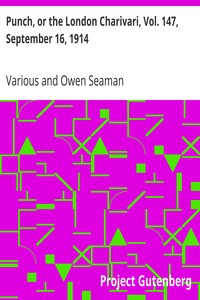
Punch, or the London Charivari, Vol. 147, September 16, 1914 by Various
Punch, or the London Charivari, Vol. 147, September 16, 1914—yep, that's a mouthful! This is basically a century-old magazine that's part joke book, part time machine. Imagine scrolling through someone's social media feed from 1914, but with better drawings and way more Britishness.
The Story
There's no traditional plot, but here's the deal: Europe had just exploded into World War I a month earlier, and ordinary Brits were trying to make sense of it. This special issue of Punch documents that moment. You'll find satirical cartoons making fun of politicians (the Kaiser gets roasted!), goofy skits about army life, and short poems that are hilarious until you realize soldiers standing there when the jokes stop. Think: one page shows a posh man arguing with a civilian about how his hat is the patriotic wrong shade; the next page talks about an officer who died bravely. The structure is loose—articles, illustrations, puns—but it all circles the big question: when do you stop laughing? And do you ever want to?
Why You Should Read It
Because it's real. This is history without filters. Most books about World War I tell you about trench tactics and generals. Punch shows you the teenager who thought signing up would be like an adventure novel and wrote to his mom super enthusiastic. Then you see, a few issues later, notice of his grave. The themes are surprisingly modern: anti-war sentiment wrapped in humor, loneliness, jealousy over soldiers' candy, intense patriotism mixed in with buying cheap socks. One poem in the issue—short as my thumb—describes a boy marching but feeling empty inside. Stick that moment? Ha, ugh, you'll remember tonight.
The characters? There's also Wilson's Mom who patrols gardens, a cynical cartoon of fear, and a very loving parade of a French family and rations. They're comic types, sure, but heart squeezes the paint strokes.
Final Verdict
Perfect for: History nerds who've read ten books about the war and just want to *feel* it. Fans of comedy that's sometimes mean the best. Seekers for a mixed reading of brilliant, flawed humans–then realizing many didn't come back. Not for people who need an ending or instant solutions. Also cool for comparing to modern dark humor—we tag words like nostalgia didn't blunt joke's edge then. No, they stab truth still shut. Read this over bubble tea, coffee, or in an hour with that twinge nodding 'yes, perfect dising into 1914'.
No rights are reserved for this publication. You can copy, modify, and distribute it freely.
Paul Hernandez
9 months agoFrom a researcher's perspective, the critical analysis of current industry standards is very timely. A rare gem in a sea of mediocre content.
Patricia Harris
5 months agoThe digital formatting makes it very easy to navigate.

Charles Johnson
4 weeks agoThis is now a staple reference in my professional collection.