
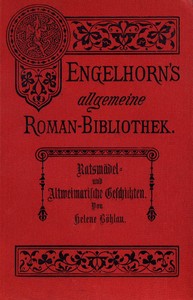
Ratsmädel- und Altweimarische Geschichten by Helene Böhlau
Helene Böhlau’s collection is a quiet masterpiece of observation. She wasn't writing grand epics about kings and wars; she was watching the people next door, the shopkeepers, the young women dreaming of something more, and the elderly holding onto memories. Published in the late 1800s, these stories capture Weimar not as a monument to Goethe, but as a living, breathing town full of ordinary souls.
The Story
The book is split into two parts. The first, 'Ratsmädel' stories, center on a spirited young girl from a humble background. We follow her as she grows up, facing the limitations placed on her by her class and gender. She navigates work, family expectations, and the first flickers of romance, all under the watchful eyes of a society that has a very specific place for her. The second part, the 'Altweimarische Geschichten,' shifts focus to the town's older generation. These are quieter, often poignant tales of lifelong residents—widows, retired craftsmen, forgotten gentlefolk—whose lives are woven into the very fabric of the city's streets. Their stories are about memory, loss, and the subtle ways a community is held together.
Why You Should Read It
Böhlau’s genius is in her empathy. She writes about these characters without judgment, letting their humanity shine through. You don't just read about the Ratsmädel's frustration; you feel the tightness of her social corset. You don't just hear an old man's tale; you sit with him in his quiet parlor and sense the weight of his years. The writing is vivid and detailed, pulling you completely into the cobblestone streets and cozy, cramped rooms of old Weimar. It’s a deeply feminist work for its time, not because the characters storm barricades, but because it insists that these women’s inner lives—their hopes, disappointments, and quiet resilience—are worthy of our full attention.
Final Verdict
This book is perfect for readers who love immersive historical fiction and rich character studies. If you enjoyed the intimate societal portraits in Jane Austen's work or the detailed realism of writers like Theodor Fontane, you'll find a kindred spirit in Helene Böhlau. It’s also a great pick for anyone interested in women's history from a ground-level perspective. Fair warning: it’s not a fast-paced plot-driven novel. It’s a slow, character-rich stroll through another time. Pour a cup of tea, settle in, and let Böhlau introduce you to a world that feels astonishingly real and deeply moving.
This content is free to share and distribute. Enjoy reading and sharing without restrictions.
Richard Harris
1 year agoSolid story.
Lucas Torres
6 months agoBased on the summary, I decided to read it and the depth of research presented here is truly commendable. A valuable addition to my collection.
Richard Lopez
2 years agoI was skeptical at first, but it manages to explain difficult concepts in plain English. I learned so much from this.
Jackson Miller
7 months agoSolid story.







Joseph Johnson
4 months agoHaving explored several resources on this, I find that the chapter on advanced strategies offers insights I haven't seen elsewhere. This should be on the reading list of every serious professional.