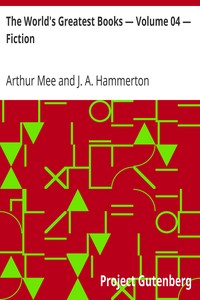
The World's Greatest Books — Volume 04 — Fiction by Arthur Mee and J. A. Hammerton
Let's clear something up first: this isn't a novel. 'The World's Greatest Books — Volume 04 — Fiction' is something much more unusual. Published around 1910, it's part of a massive series aimed at bringing classic literature to a wide audience. Editors Arthur Mee and J.A. Hammerton didn't just make a list; they compiled summaries, critical notes, and selected scenes from what they considered the essential fiction of the Western world.
The Story
There's no single plot. Instead, think of this book as a literary sampler platter from the early 20th century. You might get a condensed version of Robert Louis Stevenson's Treasure Island, followed by an analysis of its themes. Then you could jump to a scene from James Fenimore Cooper's The Last of the Mohicans, or explore the work of authors like George Eliot or Sir Walter Scott. The 'story' is the editors' journey through literature, highlighting what they felt was most important, exciting, or morally instructive. It's a guided tour, with Mee and Hammerton as your enthusiastic, opinionated docents.
Why You Should Read It
This book is a mirror held up to 1910. Reading it today is less about the stories themselves (you can read the full novels) and more about understanding the lens through which they were viewed. What did 'great' mean back then? Often, it meant adventure, clear morals, and robust storytelling. The editors' commentary is a glimpse into their values. It's also a fantastic way to discover authors who were household names then but aren't as widely read now. You get the cliff's notes version of a whole cultural mindset.
Final Verdict
This is a niche pick, but a rewarding one. It's perfect for history buffs, literature students, or any curious reader who wonders how the canon of 'classics' is built and changes over time. Don't read it for a page-turning narrative. Read it as a historical document and a conversation starter. It's the kind of book that makes you want to pull a friend aside and say, 'Get this—they thought THIS was the most important thing about this story!' A truly unique piece of literary history.
This is a copyright-free edition. You can copy, modify, and distribute it freely.
Emily Hernandez
2 years agoCompatible with my e-reader, thanks.
Robert Harris
9 months agoI had low expectations initially, however the arguments are well-supported by credible references. Worth every second.
Carol Davis
4 months agoWithout a doubt, it manages to explain difficult concepts in plain English. I couldn't put it down.
Linda Flores
2 years agoI came across this while browsing and the depth of research presented here is truly commendable. Definitely a 5-star read.
Susan Thomas
7 months agoExceptional clarity on a very complex subject.