About 326 minutes
The four Corners — Reading Notes
Historical Psychological Social Fiction
74,887 recorded words. 30 minutes difference from this book's estimate.
View Gutenberg source #45601
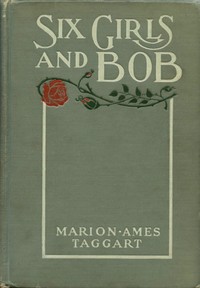
The source record for Six Girls and Bob: A Story of Patty-Pans and Green Fields — Key Ideas to Explore measures this digital text at 81,663 words, 5 hr 56 min estimated reading time, and 8 detected text sections.
The text analysis averages about 17.4 words per sentence, while the detected sections provide another way to judge how the source is divided.
Project Gutenberg metadata also associates the work with “Country life -- Juvenile fiction,” connecting these edition facts with the source record’s subject description.
Explore this collection
These alternatives are selected using recorded categories and estimated reading time.
About 326 minutes
Historical Psychological Social Fiction
74,887 recorded words. 30 minutes difference from this book's estimate.
View Gutenberg source #45601About 310 minutes
Historical Psychological Social Fiction
71,098 recorded words. 46 minutes difference from this book's estimate.
View Gutenberg source #47785About 440 minutes
Historical Psychological Social Fiction
101,156 recorded words. 84 minutes difference from this book's estimate.
View Gutenberg source #45045Search stored excerpts and compare books → Choose by your preferences →
Choices use stored catalog measurements. Estimates vary with reading speed. A shared category is a catalog label, not a claim that two books have the same argument or literary quality.
Search reads excerpt text stored with this catalog and links to its associated Gutenberg record. The connection is stored in the site database; this tool does not recheck that every excerpt is word-for-word identical to that external record. Excerpt search does not cover every chapter and does not verify historical publication dates.
Catalog snapshot checked: 2026-09-25. Coverage: 96 public books, 96 available source excerpts.
Read the complete public-domain text at its original source.
Read on Project GutenbergThe opening chapter, 'The Fourth Floor, East,' immediately establishes a tension between confinement and expanse. Happie Scollard complains that the family kitchen is 'eight feet wide' while the six sisters collectively occupy 'twelve feet'—a physical impossibility that sets up the central problem of space. The family's move to a farm in Crestville, Pennsylvania, is thus not merely a change of setting but a structural release from the cramped arithmetic of city life.
The first chapter's dialogue hinges on a numerical joke: 'How can you get twelve feet into eight feet?' Happie's question is answered not by arithmetic but by relocation. The Scollard sisters are introduced in a space that literally cannot contain them, and the narrative's early momentum comes from the need to escape this squeeze. Bob's teasing response—'You'd have to be pretty poor in arithmetic to try it'—underscores the absurdity of their situation. The cramped kitchen becomes a recurring reference point against which the later, open fields are measured.
The farmhouse is repeatedly called 'the Ark,' a biblical allusion that carries multiple meanings: a vessel of refuge, a collection of pairs, and a structure adrift. The narrator notes that 'it always surprised the inmates of the Ark that there was, apparently, no inequality of age in Crestville.' This observation links the Ark to a community where everyone knows everyone else 'with the intimacy of first names and identical ages.' The image recurs in chapter titles like 'An Ark Adrift?' and 'The Promise of the Green Branch,' reinforcing the sense of a family navigating uncertain waters.
The narrative shifts deliberately from interior to exterior. Early chapters are set in the cramped city apartment; later scenes unfold in hayfields and farmyards. In the hay-loading episode, Gretta's physical competence is contrasted with Happie's inexperience. Gretta 'swung herself up on the back of the hay wagon' and 'took command of the work' with a pitchfork, while Happie 'forgot to work, drinking in a new experience.' The movement is not just geographical but sensory: from the 'squeedged' kitchen to the 'delicious hay in the June sunshine.'
Gretta's hay-loading performance is described with unusual precision: she 'caught the great bunches of hay,' 'wielding her fork surely and gracefully,' and 'judging accurately and quickly where to place each forkful to keep the load symmetrical.' Bob, exhausted, admits she has beaten him. The scene reverses expected gender roles—Gretta works 'as well as any boy could have done'—and her skill is presented as a form of artistry. The narrator lingers on her 'brown arms,' 'tall figure,' and 'proud pleasure,' making her a central figure in the book's celebration of rural life.
Readers attentive to structure will notice how Taggart uses physical spaces—the cramped city kitchen, the Ark farmhouse, the open hayfield—to chart the sisters' adjustment. The recurring image of the Ark, with its biblical overtones of survival and renewal, gives the story a coherent symbolic framework. The excerpts suggest that the book rewards attention to these patterns of confinement and release, indoor and outdoor, rather than to plot alone.
I keep thinking how those green fields in Six Girls and Bob felt like a held breath finally released, the way the Ark becomes a floating hope rather than a cramped shelter. That quiet longing for open space stayed with me, and it surfaces again in The Temptation of St. Anthony — Reading Companion, where the desert itself feels like both prison and promise. Strange, how different books echo the same ache.
Your answers remain private and are stored only in this browser.