About 244 minutes
Betty Lee, Junior — Background and Themes
Historical Psychological Social Fiction
56,063 recorded words. 3 minutes difference from this book's estimate.
View Gutenberg source #44804
The Temptation of St. Anthony — Reading Companion can be approached with a clearer sense of reading commitment from its source measurements: 55,307 words, 4 hr 1 min estimated reading time, and 8 detected text sections.
The text analysis averages about 15.5 words per sentence, while the detected sections provide another way to judge how the source is divided.
Project Gutenberg metadata also associates the work with “Biographical fiction,” connecting these edition facts with the source record’s subject description.
Explore this collection
These alternatives are selected using recorded categories and estimated reading time.
About 244 minutes
Historical Psychological Social Fiction
56,063 recorded words. 3 minutes difference from this book's estimate.
View Gutenberg source #44804About 238 minutes
Historical Psychological Social Fiction
54,664 recorded words. 3 minutes difference from this book's estimate.
View Gutenberg source #48599About 250 minutes
Historical Psychological Social Fiction
57,495 recorded words. 9 minutes difference from this book's estimate.
View Gutenberg source #52964Search stored excerpts and compare books → Choose by your preferences →
Choices use stored catalog measurements. Estimates vary with reading speed. A shared category is a catalog label, not a claim that two books have the same argument or literary quality.
Search reads excerpt text stored with this catalog and links to its associated Gutenberg record. The connection is stored in the site database; this tool does not recheck that every excerpt is word-for-word identical to that external record. Excerpt search does not cover every chapter and does not verify historical publication dates.
Catalog snapshot checked: 2026-09-25. Coverage: 96 public books, 96 available source excerpts.
Read the complete public-domain text at its original source.
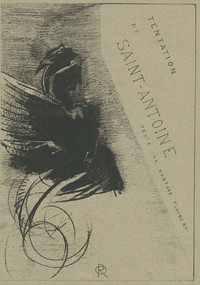
Read on Project GutenbergFlaubert's The Temptation of St. Anthony unfolds as a series of dramatic scenes rather than a continuous narrative, moving from the hermit's isolated cell to processions of ancient gods, heretics, and mythical beings. The structure relies on abrupt entrances and exits: characters like Simon Magus appear without warning, and Anthony's responses shift between resistance and reverie. Odilon Redon's illustrations, added to this edition, heighten the work's dreamlike quality, their dark, fantastical imagery echoing the text's movement between the tangible desert and the phantasmagoric.
The opening establishes Anthony's cell as a fixed point from which visions erupt. Flaubert uses stage directions—parenthetical gestures like “placing his finger to his lips”—to anchor the dialogue in physical space, even as the content grows surreal. The hermit's exclamations (“Why! she is utterly mad!”) contrast with the calm intrusions of Simon, whose speeches shift from seduction to threat. This tension between stillness and eruption recurs throughout: Anthony remains largely stationary while figures parade before him, their words and appearances transforming the cell into a theater of memory and heresy.
Simon's claim that Helen is the Moon—“she herself is the Moon!”—ties together a chain of female figures: Helen of Troy, Lucretia, Delilah, and the Gnostic Ennoia. Each is described through bodily and spatial imagery: “prostituted herself to all nations,” “kissed the faces of all men.” The moon appears at multiple loopholes simultaneously, a visual paradox that mirrors the text's own multiplication of identities. Anthony's half-remembered recognition (“it seems to me that I remember”) suggests that these images are not new but resurgent, dredged from his own suppressed knowledge.
The text alternates between intimate exchanges and sweeping catalogues. Simon's monologue lists cities (Ephraim, Issachar, Bostra, Damascus) and titles (Jupiter, Apollo, Christ, Paraclete), creating a rhythmic accumulation that mimics a procession. Anthony's brief interjections punctuate these flows, but his voice grows weaker as the visions intensify. The stage direction “He falls into a reverie” marks a threshold where dialogue gives way to internal vision, a pattern that repeats across the work's eight sections. Redon's illustrations, with their floating figures and distorted scales, visually echo this shift from conversation to hallucination.
Simon's speeches are structured as temptations: he offers knowledge of “the forces of Nature and the essence of Spirits,” appealing to Anthony's unspoken desire. The interior voice whispering “Why not?” reveals the hermit's vulnerability. Flaubert frames heresy not as abstract argument but as seductive performance—Simon claims to be “the great might of God, incarnated in the person of Simon.” Anthony's responses shrink from defiance to a mere “Ah! what is this to me?” The power dynamic shifts through gesture: Simon's “furious look” versus Anthony's reverie, suggesting that the real drama lies in the hermit's internal wavering rather than in doctrinal debate.
Though the cell is the primary setting, the desert permeates the text as a space of both isolation and invasion. Simon's travels—“beyond the Lake of Houleh, in the valley of Maggedo”—map a geography that collapses distance, bringing distant heresies to Anthony's doorstep. The desert is also a site of memory: Anthony's recollection of “the two camps, the watchfires being lighted” from Helen's story blurs his own past with mythological time. Flaubert uses this porous boundary to suggest that Anthony's temptations are not external intrusions but eruptions of a landscape already within him.
Readers attentive to Flaubert's stagecraft will notice how each vision leaves a residue: a gesture, a repeated phrase, a shift in lighting. The work rewards those who track these recurrences rather than seeking a linear plot. Redon's illustrations, placed at intervals, offer a visual counterpart to the text's own method of accumulation and transformation, inviting a reading that moves between word and image as freely as Anthony moves between faith and doubt.
Sometimes Flaubert’s hermit, lost among his own visions, feels less like a saint than a girl I knew from Marjorie Dean Macy's Hamilton Colony — both of them surrounded by ghosts of what they thought they wanted. I read the poem years ago, and still, when I close the book, I hear that quiet desert wind. There’s a gentler echo of that solitude in Marjorie Dean Macy's Hamilton Colony — Story, Setting & Ideas, though it smells of pine, not sand.
Capture what you thought, learned, and would like to remember.