About 250 minutes
Patty's Motor Car — Reading Companion
Historical Psychological Social Fiction
57,495 recorded words. 7 minutes difference from this book's estimate.
View Gutenberg source #52964
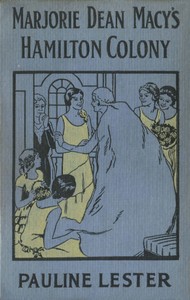
This digital edition of Marjorie Dean Macy's Hamilton Colony — Story, Setting & Ideas is described by source-level measurements including 58,921 words, 4 hr 17 min estimated reading time, and 23 detected text sections.
The text analysis averages about 13.9 words per sentence, while the detected sections provide another way to judge how the source is divided.
Project Gutenberg metadata also associates the work with “Friendship -- Juvenile fiction,” connecting these edition facts with the source record’s subject description.
Explore this collection
These alternatives are selected using recorded categories and estimated reading time.
About 250 minutes
Historical Psychological Social Fiction
57,495 recorded words. 7 minutes difference from this book's estimate.
View Gutenberg source #52964About 267 minutes
Historical Psychological Social Fiction
61,270 recorded words. 10 minutes difference from this book's estimate.
View Gutenberg source #45908About 268 minutes
Historical Psychological Social Fiction
61,580 recorded words. 11 minutes difference from this book's estimate.
View Gutenberg source #46010Search stored excerpts and compare books → Choose by your preferences →
Choices use stored catalog measurements. Estimates vary with reading speed. A shared category is a catalog label, not a claim that two books have the same argument or literary quality.
Search reads excerpt text stored with this catalog and links to its associated Gutenberg record. The connection is stored in the site database; this tool does not recheck that every excerpt is word-for-word identical to that external record. Excerpt search does not cover every chapter and does not verify historical publication dates.
Catalog snapshot checked: 2026-09-25. Coverage: 96 public books, 96 available source excerpts.
Read the complete public-domain text at its original source.
Read on Project GutenbergThe novel opens with Jerry Macy lounging on a porch rocker, squinting at a “turquoise August sky” and declaring that “something fine is going to happen.” This porch-side exchange establishes a pattern of anticipatory dialogue that recurs throughout the text. Characters frequently gather in transitional spaces—porches, doorways, newly arranged rooms—where plans are hatched and secrets are shared. The physical movement from one setting to another often mirrors shifts in social alliances or emotional revelations.
Chase uses these spatial transitions to build suspense and to underscore the importance of domestic interiors as sites of transformation. When Leslie reconfigures a room for the freshman Jewel Marie, the act of rearranging furniture becomes a metaphor for reshaping relationships. The colony itself, a boarding house for college women, functions as a stage where private histories collide with public personas.
The opening chapter hinges on Jerry’s “hunch” that something unexpected is imminent. This device—a character forecasting an event without specifying it—creates a forward momentum that carries through the early chapters. Marjorie’s list of missing people (Captain, Leila, Vera, Miss Susanna) establishes a network of absent figures whose eventual reappearance will drive the plot. The porch setting, with its open-air quality, suggests a threshold between private expectation and public arrival.
Chase repeats this technique later: when Leslie waits for Jewel Marie to reveal her secret, the pause is filled with “solemn intensity.” The narrative rhythm alternates between leisurely speculation and sudden disclosure, keeping the reader attuned to what might be about to happen.
Interior spaces in the novel are not merely backdrops but active participants in character development. Leslie’s offer to rearrange a room for Jewel Marie is accompanied by a request for a future promise—a transaction that binds the physical space to an emotional debt. The freshman’s secret, “a child of the circus,” is disclosed in this newly configured room, transforming it from a dormitory into a confessional.
Earlier, Marjorie’s room is described as invaded by a “flower-like group,” a phrase that emphasizes both the beauty and the intrusion of social life. These rooms are repeatedly reordered: beds moved, furniture bought, spaces repurposed. Each rearrangement signals a shift in power or intimacy, making the physical environment a direct index of character relationships.
Jewel Marie’s background as a former trapeze performer introduces a striking set of images that contrast with the collegiate setting. Her description of “Fernando’s Mammoth Shows” and the flood that killed her parents brings a note of peril and transience into the stable world of Hamilton Colony. The circus, with its acrobatics and constant movement, becomes a metaphor for the precariousness of identity.
Chase does not overplay this motif; it surfaces only in Jewel Marie’s confession and then recedes. Yet its singularity makes it memorable. The image of a child performing “acrobatic stunts” at age seven lingers, suggesting that the colony itself is a kind of performance space where girls must balance their past selves with their present roles.
The narrative moves fluidly from porch to room to campus, but these transitions often coincide with moments of social friction. When Jerry and Marjorie discuss absent friends, the conversation is light; when Leslie and Jewel Marie talk, the tone becomes intense. Chase uses shifts in setting to modulate the emotional register.
For instance, the station arrival scene—where Jewel Marie “put on airs”—is followed by the private room scene where she drops the pretense. This movement from public to private space mirrors the character’s journey from performance to authenticity. The colony itself, as a shared living arrangement, forces such transitions constantly, making every doorway a potential threshold for conflict or connection.
Readers attentive to spatial details will find that Chase’s architecture of rooms and thresholds offers a subtle guide to the novel’s emotional geography. The colony is not merely a setting but a mechanism: its walls, porches, and rearranged furniture shape how characters reveal themselves. Pay particular attention to who enters whose room and under what circumstances—these movements often carry more weight than the dialogue that accompanies them.
Reading about the porch conversations and shifting rooms in Marjorie Dean Macy's Hamilton Colony stirred a memory of summers at my grandmother's house, where furniture moved as people did. That same quiet ache—between belonging and leaving—came back with A Little Girl in Old Washington — Edition Insights. Both feel like watching light settle in a room, knowing it will shift again.
Use these questions to collect your thoughts before moving on.