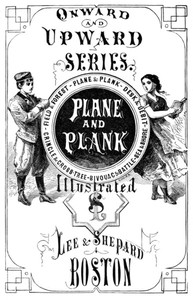
The catalog entry for Plane and Plank lists temperance, prayer, and Christian life as primary subjects, but the excerpts from the text itself spend far more time on legal negotiations and the mechanics of carpentry than on piety. In the preface, author Oliver Optic states that the hero Phil Farringford learns the carpenter's trade and that the story contrasts a diligent mechanic with one who overvalues his skill. Yet the sample chapters show Phil entangled in a police station dispute over a stolen wallet, not at a workbench. The mismatch between the catalog's moral emphasis and the actual narrative texture is the first thing a reader notices.
Carpentry as a Framework, Not a Focus
The catalog lists carpentry as a subject, and the title itself pairs a plane (the tool) with a plank (the material). However, the excerpts contain almost no description of woodworking. Phil is identified as a mechanic, but the only concrete trade detail appears in the preface, which says he learns carpentry. In the chapters provided, Phil is occupied with travel, confrontations, and detective-like inquiries. The word 'plane' appears only in the title and chapter headings; the word 'plank' is absent from the sample text. This suggests that carpentry serves as a character marker rather than a plot driver.
Temperance and the Father's Role
The catalog includes temperance as a subject, and the preface explicitly states that Phil's father's intemperance is depicted. In the excerpts, Mr. Farringford appears as a 'seedy gentleman' who trembles from inebriation. Yet the narrative does not moralize directly; instead, it uses legal and financial negotiations to handle the father's condition. Phil refuses extra money from a swindler and insists on precise restitution. The temperance lesson is embedded in procedural dialogue rather than in exhortation. Readers expecting a sermon will find a courtroom-style drama instead.
Legal Language and the Police Station Scene
The most extended excerpt takes place in a police station, where a sergeant, Mr. Gray, and Mr. Lamar debate the legality of a payment. Phrases like 'commit yourself,' 'prosecute,' and 'evidence to convict' dominate the conversation. The officer refuses to file a complaint because the crime occurred in another state. This legalistic focus is surprising for a book cataloged under Christian life and prayer. The scene resolves not through prayer but through a calculated exchange of money. The catalog's religious framing is almost invisible in this passage.
Readers approaching Plane and Plank through its catalog subjects should be prepared for a story that uses moral themes as background rather than foreground. The excerpts suggest a narrative driven by practical problem-solving, legal reasoning, and family reconciliation, with carpentry and temperance serving as context. The book rewards attention to how characters argue and negotiate, not just to the lessons they learn.
Reading about Phil Farringford’s quiet, stubborn workmanship on that riverboat reminded me of another kind of patient struggle. There’s a similar warmth in how Baseball Joe, Captain of the Team; or, Bitter Struggles on the Diamond — A Reader’s Guide follows a boy learning to steady his own hands, not for glory, but just to keep going. Friendly, earnest company, both of them.