About 212 minutes
Sally Scott of the WAVES — A Reader’s Guide
Exploration Survival Adventure Tales
48,564 recorded words. 4 minutes difference from this book's estimate.
View Gutenberg source #44813
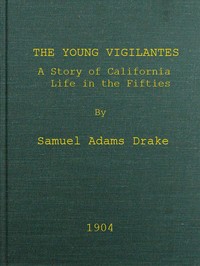
The catalog record for The Young Vigilantes: A Story of California Life in the Fifties — Story, Setting & Ideas provides practical reading context through 47,718 words, 3 hr 28 min estimated reading time, and 5 detected text sections.
The text analysis averages about 16.2 words per sentence, while the detected sections provide another way to judge how the source is divided.
Project Gutenberg metadata also associates the work with “Conduct of life -- Juvenile fiction,” connecting these edition facts with the source record’s subject description.
Explore this collection
These alternatives are selected using recorded categories and estimated reading time.
About 212 minutes
Exploration Survival Adventure Tales
48,564 recorded words. 4 minutes difference from this book's estimate.
View Gutenberg source #44813About 212 minutes
Exploration Survival Adventure Tales
48,585 recorded words. 4 minutes difference from this book's estimate.
View Gutenberg source #45236About 213 minutes
Exploration Survival Adventure Tales
48,907 recorded words. 5 minutes difference from this book's estimate.
View Gutenberg source #43374Search stored excerpts and compare books → Choose by your preferences →
Choices use stored catalog measurements. Estimates vary with reading speed. A shared category is a catalog label, not a claim that two books have the same argument or literary quality.
Search reads excerpt text stored with this catalog and links to its associated Gutenberg record. The connection is stored in the site database; this tool does not recheck that every excerpt is word-for-word identical to that external record. Excerpt search does not cover every chapter and does not verify historical publication dates.
Catalog snapshot checked: 2026-09-25. Coverage: 96 public books, 96 available source excerpts.
Read the complete public-domain text at its original source.
Read on Project GutenbergSamuel Adams Drake opens The Young Vigilantes not with a narrator's voice but with a newspaper clipping, the Morning Post-Horn, reporting a train stopped by a frantic figure on the tracks. This choice immediately establishes a documentary tone, grounding the adventure in reported fact. The excerpt's language—'shut off steam,' 'whistled for brakes,' 'fifty frightened passengers'—is brisk and journalistic, contrasting with the more colloquial dialogue that follows. Drake uses this framing to signal that his story will blend public record with private peril.
Drake distinguishes his young protagonists through speech patterns. Bill, the practical-minded companion, uses contractions and dropped consonants: 'Let's get sumfin' t' eat fust.' Walter, by contrast, speaks in more measured, standard English. When Bill reads a restaurant menu aloud, his commentary—'H'm, that don't go down'—reveals a wry, economizing mind. The author does not label these boys as class types; he lets their words do the work. Even minor characters, like the red-shirted miner who bids on a certificate, speak in compressed, idiomatic bursts: ''Tain't a patchin', boys. Sell her agin, cap—sell her agin.' Such lines evoke the Gold Rush's transactional urgency without editorializing.
One of the most detailed set pieces is the auction of a worthless certificate of deposit aboard ship. Drake renders it with precise, escalating bids: 'Ten, twenty, forty, fifty dollars,' then a woman's voice at seventy, another at one hundred. The captain halts the sale at exactly two thousand dollars, a sum that feels both arbitrary and exact. The scene functions as a compressed portrait of frontier economics—value is assigned by collective whim, not intrinsic worth. The author's choice to include a woman's bid among the men's challenges assumptions about who participates in such transactions. The gold coins 'covering the capstan' provide a concrete, tactile image of wealth made visible.
When the steamer Pacific enters the Golden Gate, Drake shifts from panoramic description to close sensory detail. The fort 'looms,' a semaphore 'works on a hilltop,' and the city 'sprung like magic from the bleak hillsides.' This is not a neutral arrival; it is a stage set for expectation. On the wharf, 'a perfect storm of greetings, questions, and answers' is 'tossed from ship to shore'—the verb choice implying both chaos and communication. Walter and Bill scan the crowd in vain for a familiar face, a detail that underscores their isolation amid the spectacle. Drake avoids romanticizing the scene; instead, he notes the 'unquiet throng' and the boys' hunger, grounding the exotic in bodily need.
Drake often compresses high-stakes action into a few brisk sentences. When the train is stopped, the engineer 'instantly shut off steam, whistled for brakes, and quickly brought the train to a standstill.' The triple verb sequence mimics the speed of the emergency. Later, the auction's climax is delivered in a single line of dialogue: 'That will do. The sale is over.' The captain's curt authority closes the scene without explanation. This restraint extends to the boys' financial straits: Walter produces 'a solitary quarter-eagle' that looks 'astonishingly small' in his palm. The simile is understated but vivid, conveying disappointment without melodrama. Such choices keep the narrative moving while leaving readers to infer the emotional weight.
Drake's prose rewards attention to its small, deliberate choices: the newspaper framing, the dialect variations, the precise sums of money, and the physical details of a city 'sprung like magic.' Readers attuned to these authorial decisions will find a layered portrait of 1850s California, one that balances adventure with a reporter's eye for the telling particular. The novel does not explain its world; it presents it, and trusts the reader to see.
There’s a particular hush in old adventure tales, that Gold Rush dust still clinging to Drake’s pages, a young man’s restlessness. It reminds me of the quiet pull I felt with Oscar in Africa, not the setting, but that same ache for a wider world, handled so tenderly there. Oscar in Africa — A Reader’s Guide shares that gentle, wondering spirit, a kinship I’ve treasured across the years.
Use these questions to collect your thoughts before moving on.