About 116 minutes
That Girl in Black; and, Bronzie — Themes and Context
Fantasy Juvenile Worlds
26,613 recorded words. 1 minutes difference from this book's estimate.
View Gutenberg source #43134
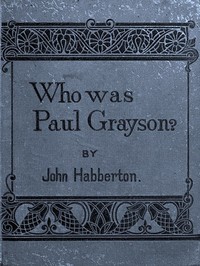
The source record for Who Was Paul Grayson? — Reading Notes measures this digital text at 26,411 words, 1 hr 55 min estimated reading time, and 14 detected text sections.
The text analysis averages about 25.0 words per sentence, while the detected sections provide another way to judge how the source is divided.
Project Gutenberg metadata also associates the work with “Conduct of life -- Juvenile fiction,” connecting these edition facts with the source record’s subject description.
Explore this collection
These alternatives are selected using recorded categories and estimated reading time.
About 116 minutes
Fantasy Juvenile Worlds
26,613 recorded words. 1 minutes difference from this book's estimate.
View Gutenberg source #43134About 111 minutes
Fantasy Juvenile Worlds
25,415 recorded words. 4 minutes difference from this book's estimate.
View Gutenberg source #49519About 104 minutes
Fantasy Juvenile Worlds
23,858 recorded words. 11 minutes difference from this book's estimate.
View Gutenberg source #43420Search stored excerpts and compare books → Choose by your preferences →
Choices use stored catalog measurements. Estimates vary with reading speed. A shared category is a catalog label, not a claim that two books have the same argument or literary quality.
Search reads excerpt text stored with this catalog and links to its associated Gutenberg record. The connection is stored in the site database; this tool does not recheck that every excerpt is word-for-word identical to that external record. Excerpt search does not cover every chapter and does not verify historical publication dates.
Catalog snapshot checked: 2026-09-25. Coverage: 96 public books, 96 available source excerpts.
Read the complete public-domain text at its original source.
Read on Project GutenbergThe opening chapter of Who Was Paul Grayson? immediately establishes a schoolyard culture of suspicion and romantic longing. The boys of Mr. Morton’s Select School are convinced that the new pupil, Paul Grayson, is an Indian—a belief born entirely from a classmate’s dream. This premise, rather than any actual plot about counterfeiters or prisoners, dominates the early excerpts. The narrative voice is wry and observant, noting how the boys “did not profess to know more than boys of the same age and advantages elsewhere” yet are “absolutely certain” about the teacher’s bell. The humor lies in the contrast between the boys’ desire for adventure and the mundane explanations Paul offers: his knowledge of birch canoes comes from Maine, not the Wild West; his buffalo sightings are from Central Park. The catalog subjects list “Counterfeiters” and “Prisoners,” but the excerpts show that the story’s engine is the boys’ collective fantasy, not criminal intrigue.
The central misunderstanding—that Paul is an Indian chief’s son—is treated with surprising narrative restraint. The boys’ questions are earnest: “Do the Indians really kill or torture all the white people they catch?” Paul’s answers deflate their expectations. He notes that “nearly all the Indians have rifles nowadays,” which the boys find “very unromantic.” The scene hinges on Benny Mallow, who dreamed the entire identity and then convinced the others. When Paul laughs off the notion, the other boys feel “as if in some way Paul had cheated them.” The excerpts do not reveal whether Paul has any hidden background, but the text is clearly more interested in the psychology of belief than in verifying identity. The catalog subject “Children — Conduct of life” is visible here: the boys must learn to reconcile their fantasies with evidence.
Habberton’s prose is precise about social hierarchies. Bert Sharp, who has “three consecutive absences to explain,” stands at the door, excluded. Napoleon Nott, called “Notty,” is timid enough to dodge behind another boy. The dialogue is naturalistic: boys interrupt each other, repeat questions, and react in clusters. When Paul reveals his knowledge comes from books and newspapers, Benny “sighed” and wished for the bell. The teacher, Mr. Morton, is a distant authority whose bell is resented. The excerpts show a community governed by unwritten rules—who can ask questions, who believes whom, and how embarrassment is managed. The catalog lists “Etiquette” as a subject, and indeed the boys’ conduct (or misconduct) is a constant undercurrent. The narrative voice is adult and slightly amused, but never condescending.
The catalog subjects include “Counterfeiters — Juvenile fiction” and “Prisoners — Juvenile fiction,” yet the excerpts contain no mention of either. The chapter titles hint at these elements—“Those Jail-birds,” “The Counterfeiter’s Cell”—but the provided text focuses entirely on the schoolyard. This discrepancy suggests that the novel may shift genres midway, from a comedy of manners to an adventure story. The excerpts also show no evidence of the “Music” subject, though a chapter is titled “Music and Manners.” Readers should be aware that the catalog reflects the full book, not the opening. The excerpts are best read as a self-contained episode about the power of suggestion and the fragility of reputation among schoolboys. The illustrations listed—such as “Attack on the Organ-grinder” and “The Window of the Counterfeiter’s Cell”—promise action that the opening chapters deliberately withhold.
The excerpts from Who Was Paul Grayson? offer a concentrated study in how a community constructs and then dismantles a shared fiction. Readers who approach the book expecting a straightforward adventure may be surprised by the slow, ironic buildup. Pay attention to the way Habberton uses dialogue to reveal character: each boy’s question tells us as much about him as about Paul. The later chapters may deliver the counterfeiters and prisoners promised by the catalog, but the opening suggests that the real drama is social, not criminal.
The rain kept me indoors with Who Was Paul Grayson?, its Victorian manners and muddled identities settling like tea leaves. That afternoon’s quiet blurred into a thought about how we inherit our roles—and I drifted, almost without deciding, to Betty Lee, Senior — Themes and Context, where those same expectations feel even younger, more fragile. One story simply handed me the next.
Create a short personal record of your experience with this book.