About 387 minutes
The Stories Polly Pepper Told to the Five Little Peppers in the Little Brown House — Reading Companion
Fantasy Juvenile Worlds
88,955 recorded words. 25 minutes difference from this book's estimate.
View Gutenberg source #49471
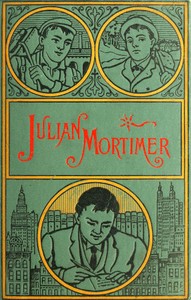
This digital edition of Julian Mortimer: A Brave Boy's Struggle for Home and Fortune — Reading Notes is described by source-level measurements including 94,622 words, 6 hr 52 min estimated reading time, and 34 detected text sections.
The text analysis averages about 20.2 words per sentence, while the detected sections provide another way to judge how the source is divided.
Project Gutenberg metadata also associates the work with “Conduct of life -- Juvenile fiction,” connecting these edition facts with the source record’s subject description.
Explore this collection
These alternatives are selected using recorded categories and estimated reading time.
About 387 minutes
Fantasy Juvenile Worlds
88,955 recorded words. 25 minutes difference from this book's estimate.
View Gutenberg source #49471About 378 minutes
Fantasy Juvenile Worlds
86,876 recorded words. 34 minutes difference from this book's estimate.
View Gutenberg source #45659About 338 minutes
Fantasy Juvenile Worlds
77,633 recorded words. 74 minutes difference from this book's estimate.
View Gutenberg source #52610Search stored excerpts and compare books → Choose by your preferences →
Choices use stored catalog measurements. Estimates vary with reading speed. A shared category is a catalog label, not a claim that two books have the same argument or literary quality.
Search reads excerpt text stored with this catalog and links to its associated Gutenberg record. The connection is stored in the site database; this tool does not recheck that every excerpt is word-for-word identical to that external record. Excerpt search does not cover every chapter and does not verify historical publication dates.
Catalog snapshot checked: 2026-09-25. Coverage: 96 public books, 96 available source excerpts.
Read the complete public-domain text at its original source.
Read on Project GutenbergHarry Castlemon opens Julian Mortimer with a sunset scene in Bridger's Pass, introducing two horsemen whose appearances are sharply contrasted. The trapper is described through rugged details—"a giant in strength and stature," with skin "as brown as an Indian's" and eyes "as sharp as those of an eagle"—while the boy Julian is defined by his fear and desperation. This initial pairing establishes a pattern of physical description that signals character roles without relying on explicit exposition.
Castlemon's dialogue is marked by phonetic spelling and regional idioms, such as "I'm a comin', an' if I don't overhaul you thar ain't no snakes." This choice gives the trapper Silas Roper a distinct voice, while Julian's speech remains more standard, highlighting his youth and relative refinement. The author also uses the landscape—rocky passes, tall grass, and darkness—to create obstacles that drive the action, as when a "blinding sheet of flame" erupts from the gloom during a chase.
Castlemon assigns each character a distinct linguistic register. The trapper Silas Roper speaks in a heavy dialect: "I reckon I throwed away that chunk of lead, didn't I?" and "You're lively on your legs fur a little one." His grammar and vocabulary—"sartin," "howsomever," "purty near"—mark him as a frontier type, while Julian's responses are grammatically conventional: "I begin to believe you are." This contrast is not merely decorative; it reinforces the power dynamic between the experienced guide and the naive boy. The villain Sanders is also given dialect speech, but with a menacing edge: "I'm a comin', an' if I don't overhaul you thar ain't no snakes." The author uses these vocal differences to help readers track alliances and threats without needing explicit narration.
Castlemon builds tension by withholding key facts from both Julian and the reader. When Silas reveals that Julian's father and brother are alive, he refuses to say where they are: "I don't know whar he is—that's the reason." Julian's repeated attempts to extract information—"He taxed his ingenuity to the utmost, and propounded his inquiries in a dozen different ways"—are all rebuffed. This creates a sustained mystery that drives the narrative forward. The author also introduces threats obliquely: Sanders, who had been presumed gone, reappears in pursuit, and Silas's cryptic comment "You'll hear and see more of him durin' the next few weeks than you'll like" hints at ongoing danger. The reader shares Julian's uncertainty, making the story's revelations more impactful.
The landscape in the excerpts is not a passive backdrop but an active participant in the plot. The opening paragraph describes "the rocky and almost impassible road that ran through Bridger's Pass" and "the shadows of twilight" creeping through the valley. During the chase, darkness and tall grass obscure vision, allowing Silas to ambush Sanders. Julian's flight is described in terms of physical effort: "Fear lent Julian wings, and he made headway astonishingly." The setting also provides cover for the pursuer, as when "a blinding sheet of flame shot out of the gloom." Castlemon uses natural features—mountains, passes, grass—to create obstacles and opportunities, grounding the adventure in a specific, rugged environment that shapes the characters' actions.
Castlemon's action sequences are concise and focused on physical movement. The chase scene is built from short, declarative sentences: "Fear lent Julian wings," "his pursuer gained rapidly," "Julian had run squarely into the arms of Silas Roper." The author avoids lengthy descriptions of emotion, instead letting the characters' actions convey urgency. Dialogue is interwoven with action: "It's no use, Julian," said a gruff voice behind him. "I'm a comin'..." This technique keeps the pace swift. After the rescue, the conversation between Julian and Silas shifts to exposition, but even then, the author parcels out information sparingly. The result is a style that prioritizes momentum over introspection, fitting for a juvenile adventure serial.
Readers approaching Julian Mortimer should attend to how Castlemon uses dialect, landscape, and withheld information to create a sense of frontier danger. The excerpts suggest a story that moves quickly, with characters defined more by their speech and actions than by interior reflection. The author's choices in these early chapters establish a pattern of suspense and revelation that likely continues throughout the novel.
Reading how Mortimer’s journey hinges on small, patient observations of unfamiliar places, I found myself thinking of Two Little Pilgrims' Progress: A Story of the City Beautiful — Reading Companion. Both books share that quiet wonder of children measuring an immense world step by step—not conquering it, just noticing where they stand. There’s a tenderness in that, a memory of being small against something vast.
A brief reflection can help important ideas stay with you longer.