About 378 minutes
Girls New and Old — A Reader’s Guide
Fantasy Juvenile Worlds
86,876 recorded words. 9 minutes difference from this book's estimate.
View Gutenberg source #45659
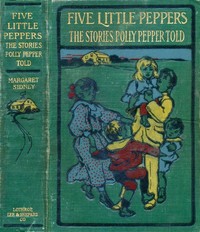
The Stories Polly Pepper Told to the Five Little Peppers in the Little Brown House — Reading Companion can be approached with a clearer sense of reading commitment from its source measurements: 88,955 words, 6 hr 27 min estimated reading time, and 29 detected text sections.
The text analysis averages about 17.0 words per sentence, while the detected sections provide another way to judge how the source is divided.
Project Gutenberg metadata also associates the work with “Family -- Juvenile fiction,” connecting these edition facts with the source record’s subject description.
Explore this collection
These alternatives are selected using recorded categories and estimated reading time.
About 378 minutes
Fantasy Juvenile Worlds
86,876 recorded words. 9 minutes difference from this book's estimate.
View Gutenberg source #45659About 412 minutes
Fantasy Juvenile Worlds
94,622 recorded words. 25 minutes difference from this book's estimate.
View Gutenberg source #51738About 338 minutes
Fantasy Juvenile Worlds
77,633 recorded words. 49 minutes difference from this book's estimate.
View Gutenberg source #52610Search stored excerpts and compare books → Choose by your preferences →
Choices use stored catalog measurements. Estimates vary with reading speed. A shared category is a catalog label, not a claim that two books have the same argument or literary quality.
Search reads excerpt text stored with this catalog and links to its associated Gutenberg record. The connection is stored in the site database; this tool does not recheck that every excerpt is word-for-word identical to that external record. Excerpt search does not cover every chapter and does not verify historical publication dates.
Catalog snapshot checked: 2026-09-25. Coverage: 96 public books, 96 available source excerpts.
Read the complete public-domain text at its original source.
Read on Project GutenbergIn the excerpt from 'The Robbers and their Bags,' Polly Pepper's storytelling voice reveals a careful modulation of pace. She begins with a rapid sequence of actions—the cat waking the mistress, the robbers being marched to jail—but repeatedly pauses for the listeners' interjections. Phronsie's anxious pleas ('Oh, do let them out!') and Joel's abrupt questions ('Pig-pens?') force Polly to slow down, clarify, and reassure. These interruptions are not disruptions but integral to the narrative rhythm, as Polly adjusts her tale to maintain suspense while soothing her youngest audience.
The excerpt demonstrates that Polly's storytelling is a collaborative performance. When Phronsie begs for the robbers to be let out, Polly does not simply refuse; she explains the danger ('they'd kill that nice, dear old cat'). This moment of reasoning slows the action, turning a chase into a moral lesson. Similarly, Joel's query about 'pig-pens' derails the description, but Polly corrects him with a laugh and redefines the setting as 'prisoners' pens.' These exchanges show Polly using interruptions to recalibrate her story's pace—speeding up after a clarification, or lingering on a detail to satisfy curiosity. The listeners' voices become part of the narrative machinery, dictating when to race forward and when to pause.
Polly employs repetition to build tension. The phrase 'off they all went to jail' is echoed in the cat's command ('Now away to jail!') and later in the description of the procession. Each repetition adds a new detail: the size of the jail, the iron key, the 'row of pens.' This incremental layering creates a sense of mounting inevitability. Yet Polly also uses repetition for comic effect—the robbers 'scream and beg' inside their bags, a refrain that Phronsie latches onto. The balance between suspense and humor is delicate; Polly never lets the story become too frightening, as Grandpapa's interjection ('it is not safe for Polly to let those bad robbers out') provides adult authority that reassures the children. The pace thus oscillates between urgent action and gentle reassurance.
The 'wise old cat' functions as a narrative engine, driving the plot forward with commands and actions. Polly gives the cat a brisk, imperative voice ('Shoulder your bags, every one of you!'), which contrasts with the robbers' pleading and the children's anxious questions. The cat's movements are described in quick strokes—'raced along as hard as she could,' 'jumped up to the table'—creating a visual rhythm that propels the story. Meanwhile, Polly's own narration slows when describing the cat's interactions with the gateman, using dialogue to stretch time. The cat's authority also mirrors Polly's role as storyteller: both control the flow of events, deciding when to hurry and when to dwell. This parallel between narrator and character reinforces the theme of storytelling as an act of gentle mastery.
Readers attentive to narrative voice will notice how Polly Pepper's stories are shaped as much by her audience as by her own imagination. The interruptions, repetitions, and shifts in tempo are not flaws but features of a living performance. To appreciate the craft, pay attention to where Polly speeds up or slows down—and to who prompts those changes. The result is a tale that feels spontaneous yet carefully orchestrated, a quality that distinguishes these embedded stories from the frame narrative around them.
Reading how Polly Pepper catches her breath between moments of danger and comfort, I found myself thinking of Connie Carl at Rainbow Ranch — Themes and Context. Both stories hold that same tender pause—where a wild tale settles into a quieter, safer place. It reminded me of evenings when the world outside felt large, but the telling made it small.
Capture what you thought, learned, and would like to remember.