About 290 minutes
Dixie Martin, the Girl of Woodford's Cañon — Themes and Context
Fantasy Juvenile Worlds
66,623 recorded words. 1 minutes difference from this book's estimate.
View Gutenberg source #46871
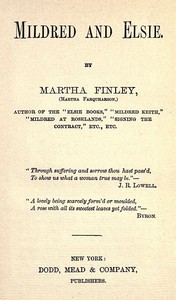
Mildred and Elsie — A Closer Reading can be approached with a clearer sense of reading commitment from its source measurements: 66,897 words, 4 hr 51 min estimated reading time, and 9 detected text sections.
The text analysis averages about 18.2 words per sentence, while the detected sections provide another way to judge how the source is divided.
Project Gutenberg metadata also associates the work with “Christian life -- Juvenile fiction,” connecting these edition facts with the source record’s subject description.
Explore this collection
These alternatives are selected using recorded categories and estimated reading time.
About 290 minutes
Fantasy Juvenile Worlds
66,623 recorded words. 1 minutes difference from this book's estimate.
View Gutenberg source #46871About 294 minutes
Fantasy Juvenile Worlds
67,485 recorded words. 3 minutes difference from this book's estimate.
View Gutenberg source #50475About 294 minutes
Fantasy Juvenile Worlds
67,555 recorded words. 3 minutes difference from this book's estimate.
View Gutenberg source #54887Search stored excerpts and compare books → Choose by your preferences →
Choices use stored catalog measurements. Estimates vary with reading speed. A shared category is a catalog label, not a claim that two books have the same argument or literary quality.
Search reads excerpt text stored with this catalog and links to its associated Gutenberg record. The connection is stored in the site database; this tool does not recheck that every excerpt is word-for-word identical to that external record. Excerpt search does not cover every chapter and does not verify historical publication dates.
Catalog snapshot checked: 2026-09-25. Coverage: 96 public books, 96 available source excerpts.
Read the complete public-domain text at its original source.
Read on Project GutenbergMartha Finley opens Mildred and Elsie with a dawn tableau that immediately establishes the novel's descriptive and moral register. Mildred awakens to a 'cool, refreshing breeze, laden with woodland sweets and wild birds' songs,' a sensory prelude that gives way to an internal crisis: 'Oh what shall I do? What ought I to do?' The juxtaposition of natural beauty and spiritual anxiety is characteristic of Finley's method. The prose moves fluidly between panoramic landscape—'wooded hills, falling waters, wild glens'—and intimate gesture, as Mildred kneels at the window, then turns to Scripture for guidance. This opening scene encapsulates the authorial choice to render moral questions through physical settings and bodily reactions, a pattern that recurs throughout the excerpts.
Finley's diction in the excerpts consistently elevates ordinary domestic actions into moral signifiers. When Mildred offers to play music for her father, the act is framed as 'restful and cheering to him after his day's work and worry.' The language of service—'I'm never too tired to play for father or mother'—is presented without irony, establishing a lexicon of filial duty. Similarly, the mother's praise—'What comforts and blessings you are to me!'—uses a religious vocabulary to describe household help. Even the youngest child, Fan, participates: 'I'm not of much use yet, mother, 'cept to love you,' she says, holding up a hemmed handkerchief. The stitching becomes evidence of moral growth. Finley's word choices—'darling,' 'dear,' 'blessing'—create a consistent tonal atmosphere where every interaction reinforces a shared value system.
The dialogue in the excerpts reveals character through speech patterns and conversational roles. Mildred's speech is measured and self-sacrificing: 'how little time I shall have left for helping you!' she sighs. Zillah's retort—'Now, Milly, don't try to make yourself of so much importance!'—is playful but pointed, using a bantering tone to check Mildred's tendency toward self-deprecation. Ada joins in with practical reassurance: 'if we can't do something to help mother in all that time we'll deserve to be called lazy girls.' The mother's voice is uniformly approving, delivering lines like 'We shall do nicely, I am sure' with a 'pleased, loving glance.' Finley uses these exchanges to model a family dynamic where verbal correction is gentle and collective problem-solving is the norm. The squire's hesitant speech—'Ah! I hardly dare go on lest you should think me presuming'—contrasts with the family's directness, marking him as an outsider to their intimate circle.
Finley's descriptive passages do more than set scenes; they externalize inner states. The opening panorama—'a grand panorama of wooded hills, falling waters, wild glens and forests and craggy mountains'—is immediately followed by Mildred's blush and sigh as her gaze falls on a 'nearer hill-top.' The landscape becomes a mirror for unspoken emotion. Later, the 'cool, refreshing breeze' that wakes Mildred is personified as 'softly kissed' her cheek, blending natural and human tenderness. Finley also uses light and color symbolically: the sun 'burst through the golden gate' and 'rejoicing as a strong man to run a race,' a biblical echo that aligns natural cycles with divine order. The 'wreaths of gray mist' that 'crept slowly up the mountain sides' introduce a note of uncertainty before Mildred's moral crisis is revealed. Description in this novel is never neutral; it is always charged with the character's emotional and spiritual state.
The excerpts reveal a structural pattern that alternates between moments of quiet reflection and bursts of practical activity. The first chapter moves from Mildred's solitary dawn meditation to the sounds of servants 'astir setting the house to rights.' Later, a scene of music and conversation is interrupted by the squire's arrival, which introduces a new plot element—the school—and shifts the family's focus to communal planning. Finley often uses these transitions to underscore the balance between inner life and social duty. The family's discussion of schedules—'four hours after we leave our beds' and 'an hour or more at noon'—shows how time is parceled out among music lessons, sewing, and school. This rhythmic structure, built around morning, evening, and domestic tasks, gives the novel a cyclical, reassuring pace. Even the children's lessons are integrated into the flow: 'I can easily hear Fan's and Annis's little lessons every day while sewing,' the mother says, weaving education into the fabric of household work.
Readers approaching Mildred and Elsie will find a novel that rewards attention to its small, deliberate details—the hem of a handkerchief, the phrasing of a request, the angle of morning light. Finley's authorial choices in diction, dialogue, and description consistently transform the ordinary into the morally significant. The excerpts suggest a work less concerned with dramatic plot than with the texture of daily life as a stage for spiritual and familial growth. Those who enjoy period domestic fiction with a strong religious framework will find here a careful, affectionate portrait of a household in motion.
There’s a particular hush in Mildred’s quietest chapters, the ones where her scruples feel heavier than the domestic bustle around her. It reminds me of the camaraderie in Beaufort Chums — A Reader’s Guide, where small tribulations ache with similar tenderness. I often think of those scenes when I miss simpler, slower worries. Some books just linger that way.
Use these questions to collect your thoughts before moving on.