About 360 minutes
Boris the Bear-Hunter — Context and Discussion
Exploration Survival Adventure Tales
82,751 recorded words. 0 minutes difference from this book's estimate.
View Gutenberg source #45098
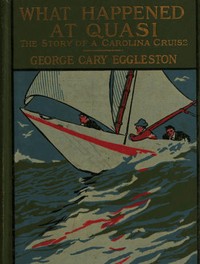
The catalog record for What Happened at Quasi: The Story of a Carolina Cruise — Inside the Classic provides practical reading context through 82,695 words, 6 hr estimated reading time, and 44 detected text sections.
The text analysis averages about 18.2 words per sentence, while the detected sections provide another way to judge how the source is divided.
Project Gutenberg metadata also associates the work with “Adventure stories,” connecting these edition facts with the source record’s subject description.
Explore this collection
These alternatives are selected using recorded categories and estimated reading time.
About 360 minutes
Exploration Survival Adventure Tales
82,751 recorded words. 0 minutes difference from this book's estimate.
View Gutenberg source #45098About 365 minutes
Exploration Survival Adventure Tales
83,927 recorded words. 5 minutes difference from this book's estimate.
View Gutenberg source #55021About 344 minutes
Exploration Survival Adventure Tales
78,946 recorded words. 16 minutes difference from this book's estimate.
View Gutenberg source #53544Search stored excerpts and compare books → Choose by your preferences →
Choices use stored catalog measurements. Estimates vary with reading speed. A shared category is a catalog label, not a claim that two books have the same argument or literary quality.
Search reads excerpt text stored with this catalog and links to its associated Gutenberg record. The connection is stored in the site database; this tool does not recheck that every excerpt is word-for-word identical to that external record. Excerpt search does not cover every chapter and does not verify historical publication dates.
Catalog snapshot checked: 2026-09-25. Coverage: 96 public books, 96 available source excerpts.
Read the complete public-domain text at its original source.
Read on Project GutenbergThe first chapter, “Interstate Chumming,” immediately establishes a tone of camaraderie and practical problem-solving as the young protagonists plan a Carolina cruise. The dialogue is brisk, and the setting—a coastal landscape of inlets and islands—is sketched with enough detail to suggest both leisure and latent danger. Early on, the narrative voice favors direct action over introspection, a pattern that holds through the middle excerpts.
In Chapter XIX, “Why Larry Was Ready for Battle,” the story pauses for an extended constitutional discussion. Larry Rutledge delivers a lecture on the limits of government power, arguing that Congress cannot pass laws violating the Constitution. The exchange is notable for its earnestness and length—over several pages—and for the way it frames the boys’ resistance to revenue officers as a principled stand. Tom’s admission that he “needed it badly” signals that the author intends this as a didactic moment. Readers encountering this passage mid-book will find the adventure temporarily subordinated to political philosophy, a shift that may surprise those expecting non-stop action.
Chapter XX, “Aboard the Cutter,” shifts perspective to the revenue officers. The boatswain, having encountered the boys, decides to report fully rather than conceal his failure to arrest them. The lieutenant’s reaction upon hearing Larry’s name—“What did you say his name is?”—and his half-laugh suggest a prior acquaintance or reputation. This moment, brief but pointed, hints at connections between the young adventurers and the adult authorities, a thread that may develop later. The excerpt leaves the reader curious about Larry’s family background and how it might influence the plot.
Later chapters introduce a hermit figure, Rudolf Dunbar, who occupies much of the second half. The table of contents lists “The Hermit of Quasi” and “Rudolf Dunbar’s Account of Himself,” suggesting a backstory that may explain the island’s mysteries. The climactic discovery of a keg that “suddenly fell to pieces” when Tom tugs at it (page 353) points to buried contraband or treasure. This physical object, combined with the hermit’s presence, creates a concrete mystery that the opening chapters only vaguely foreshadow. Readers will find the later excerpts more focused on uncovering secrets than on the earlier debates about liberty.
The excerpts reveal a consistent third-person narrator who favors dialogue and action over description. The boys’ speech is colloquial but occasionally elevated during the constitutional debate. The author, George Cary Eggleston, was known for historical and adventure fiction, and this work fits that mold. The structure—alternating between group dynamics, moral lessons, and suspense—suggests a deliberate pacing. The early chapters build a sense of normalcy, the middle chapters introduce ideological conflict, and the later chapters pivot to physical danger and discovery. This three-part rhythm is typical of boys’ adventure stories of the period, but the specific legal arguments give this book a distinctive flavor.
Readers approaching What Happened at Quasi for the first time should note that the book’s pleasures lie not only in outdoor escapades but also in its earnest discussions of citizenship and duty. The excerpts suggest that the mystery of Quasi—whatever it is—will be resolved through a combination of courage, resourcefulness, and the principles Larry articulates. Pay attention to the hermit’s story and the buried keg; they are the keys to the title’s promise.
Reading the editorial notes on What Happened at Quasi, I kept returning to how slowly its mystery unfolds, like a porch chair creaking into place. That unhurried revelation reminded me of Ned in the Block-House: A Tale of Early Days in the West — A Closer Reading, where the frontier waits just as patiently, and everything feels a little older, a little wiser, than the adventure first suggests.
Capture what you thought, learned, and would like to remember.