About 134 minutes
The Blissylvania Post-Office — Story, Setting & Ideas
Fantasy Juvenile Worlds
30,711 recorded words. 8 minutes difference from this book's estimate.
View Gutenberg source #48552
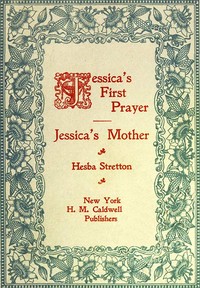
For Jessica's First Prayer; and, Jessica's Mother — Story, Setting & Ideas, the stored edition analysis reports 28,960 words, 2 hr 6 min estimated reading time, and 24 detected text sections.
The text analysis averages about 24.1 words per sentence, while the detected sections provide another way to judge how the source is divided.
Project Gutenberg metadata also associates the work with “Christian life -- Juvenile fiction,” connecting these edition facts with the source record’s subject description.
Explore this collection
These alternatives are selected using recorded categories and estimated reading time.
About 134 minutes
Fantasy Juvenile Worlds
30,711 recorded words. 8 minutes difference from this book's estimate.
View Gutenberg source #48552About 116 minutes
Fantasy Juvenile Worlds
26,613 recorded words. 10 minutes difference from this book's estimate.
View Gutenberg source #43134About 115 minutes
Fantasy Juvenile Worlds
26,411 recorded words. 11 minutes difference from this book's estimate.
View Gutenberg source #52644Search stored excerpts and compare books → Choose by your preferences →
Choices use stored catalog measurements. Estimates vary with reading speed. A shared category is a catalog label, not a claim that two books have the same argument or literary quality.
Search reads excerpt text stored with this catalog and links to its associated Gutenberg record. The connection is stored in the site database; this tool does not recheck that every excerpt is word-for-word identical to that external record. Excerpt search does not cover every chapter and does not verify historical publication dates.
Catalog snapshot checked: 2026-09-25. Coverage: 96 public books, 96 available source excerpts.
Read the complete public-domain text at its original source.
Read on Project GutenbergThe coffee-stall keeper under the railway arch is introduced with a gravity that borders on the secretive: he is a “tall, spare, elderly man, with a singularly solemn face” who “glide[s] away with a soft footstep and a mysterious and fugitive air.” Stretton’s descriptive precision—the “trestle and board,” the “two large tin cans with a small fire of charcoal burning under each”—anchors the story in a specific, gritty London setting. The stall is a “favorite” not for its warmth but for its “private niche,” a detail that hints at the social shame of being seen taking an out-of-door breakfast. This opening establishes a world where every object and gesture carries moral weight, and where the narrator’s eye for material detail will serve as a steady guide through the children’s spiritual and domestic trials.
Stretton’s diction often does the work of characterization in a single word. The coffee-stall keeper is “solemn” before we know anything else about him; the minister’s study is filled with “profound and scholarly volumes,” but the small pocket-Bible on the chimney-piece is “worn with much reading.” The contrast is not stated but built into the adjectives: the books on the table are elaborate, the Bible is worn. When Winny takes that Bible and “lifted it to her lips and kissed it fondly,” the gesture feels earned because the description has already made the book a physical token of intimacy. Similarly, Jessica’s mother’s “strokes” are “sharp and soon over, but the smart lasted a long while”—the shift from physical to emotional pain is compressed into a single sentence. These lexical choices give the prose a quiet, cumulative force.
The children’s speech in the minister’s study is notably spare and direct. When Jane asks, “Does a stroke last long, Jessica?” and Jessica answers, “I’m not sure. Mother’s strokes were sharp and soon over, but the smart lasted a long while. Maybe the stroke is now over, but perhaps the smart will last a little while. God knows,” the dialogue does not explain that Jessica is conflating a medical stroke with her mother’s physical abuse—it lets the reader infer. Winny’s remark, “Believing is a deal harder than knowing,” is given “with a look wonderfully like her father’s,” a phrase that links her wisdom to the absent minister without overstating it. Stretton trusts her young characters to speak in ways that are both childlike and theologically acute, and she does not interrupt their exchanges with authorial gloss.
Settings in these stories are not backdrops but moral landscapes. The coffee-stall occupies a “screened and secluded corner” under a railway bridge—a liminal space between public and private, shelter and exposure. The minister’s study is described with a careful inventory: the table with “slips of paper upon which he had jotted down some of the profound thoughts,” the easy-chair, the worn Bible. The room’s arrangement tells us what the minister values, and the children’s familiarity with the Bible (Winny kisses it) shows how domestic practice shapes belief. Later, when the minister is carried upstairs, the children “crept by one impulse to the door” and saw “their father’s face as he was carried past them, pale but peaceful.” The doorway becomes a threshold between knowledge and helplessness, a recurring spatial motif in Stretton’s moral geography.
Stretton’s narrator maintains a steady, almost documentary tone, but occasionally a phrase reveals a sympathetic intelligence behind the observation. The coffee-stall keeper “cared only to serve the busy workmen without hindering them by any gossip”—the word “only” quietly endorses his reticence. When the minister’s sermon was “to have astonished and electrified even his accustomed hearers,” the irony is gentle: the elaborate sermon is never delivered, and the little Bible matters more. The narrator never mocks the characters’ limitations, but neither does she sentimentalize them. Jessica “hung back shyly” at the minister’s door, and the narrator does not explain her hesitation; the gesture is allowed to stand. This restraint gives the reader room to observe the children’s world without being told what to feel.
Readers attentive to Stretton’s craft will notice how often a single object—a coffee-can, a Bible, a doorstep—carries the weight of a character’s inner life. The stories reward a slow reading that pauses on the adjectives and the silences between speeches. Because the excerpts are incomplete, the full arc of Jessica’s relationship with the coffee-stall keeper and the minister’s family remains unknown, but the patterns of diction and domestic detail visible here offer a reliable entry into Stretton’s method.
Reading about Jessica’s ragged clothes and her quiet, fearless prayers, I found myself thinking of another small, determined figure. There’s something in Sarah’s solitary ride through the Carolinas—that same blend of vulnerability and stubborn courage. Both stories feel like whispers from a past where faith was a steady hand in the dark, not a spectacle. Sarah Dillard's Ride: A Story of the Carolinas in 1780 — Reading Notes lingers in my mind the same way.
A brief reflection can help important ideas stay with you longer.