About 243 minutes
Betty Lee, Senior — Themes and Context
Fantasy Juvenile Worlds
55,883 recorded words. 3 minutes difference from this book's estimate.
View Gutenberg source #44808
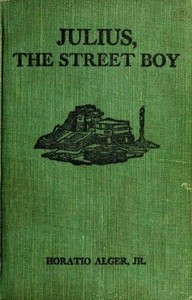
For Julius, the Street Boy; or, Out West — Themes and Context, the stored edition analysis reports 55,190 words, 4 hr estimated reading time, and 6 detected text sections.
The text analysis averages about 12.7 words per sentence, while the detected sections provide another way to judge how the source is divided.
Project Gutenberg metadata also associates the work with “Conduct of life -- Juvenile fiction,” connecting these edition facts with the source record’s subject description.
Explore this collection
These alternatives are selected using recorded categories and estimated reading time.
About 243 minutes
Fantasy Juvenile Worlds
55,883 recorded words. 3 minutes difference from this book's estimate.
View Gutenberg source #44808About 243 minutes
Fantasy Juvenile Worlds
55,879 recorded words. 3 minutes difference from this book's estimate.
View Gutenberg source #46269About 244 minutes
Fantasy Juvenile Worlds
56,054 recorded words. 4 minutes difference from this book's estimate.
View Gutenberg source #46437Search stored excerpts and compare books → Choose by your preferences →
Choices use stored catalog measurements. Estimates vary with reading speed. A shared category is a catalog label, not a claim that two books have the same argument or literary quality.
Search reads excerpt text stored with this catalog and links to its associated Gutenberg record. The connection is stored in the site database; this tool does not recheck that every excerpt is word-for-word identical to that external record. Excerpt search does not cover every chapter and does not verify historical publication dates.
Catalog snapshot checked: 2026-09-25. Coverage: 96 public books, 96 available source excerpts.
Read the complete public-domain text at its original source.
Read on Project GutenbergJulius, a New York street boy, opens the novel by announcing he has “retired from business”—a phrase that immediately signals Alger’s characteristic blend of humor and aspiration. The dialogue with Patrick Riley establishes a central contrast: Pat values the city’s lively dangers (“there’s always something to make it lively here”), while Julius, with vague geography (“more’n a hundred miles”), sets out for the West to “grow up respectable.” The excerpts show Alger’s ear for vernacular speech and his interest in the theatrical—Pat’s basement “Grand Duke’s Oprea House” offers five-cent tickets and amateur jigs, a world away from the formal declamation that later appears in the schoolroom.
Mr. Slocum, the teacher, is introduced through his own boastful speech: he claims the principal of a “celebrated institution in Maine” told him he was a natural orator and that students voted against a prize because “Slocum will be sure to get it.” The boys’ amused reaction—calling him a “regular steam engine”—shows Alger using the teacher’s vanity as a source of comedy and as a foil for Julius’s more modest efforts. The narrative does not endorse Slocum’s self-assessment; instead, it lets his words undercut him. When the boys request a demonstration, they do so with “perfectly sober” faces while laughing inside, a detail that reveals a quiet, collective resistance to authority. This episode also sets up a contrast between Slocum’s inflated oratory and Julius’s careful preparation, as Julius recites at home to Mr. Taylor and receives “several suggestions” that prove valuable.
The opening dialogue establishes a tension between urban and rural life that runs through the excerpts. Pat dismisses the country because “there ain’t no murders, nor burglaries, nor nothin’,” while Julius, though fond of the theater, is willing to leave. The boys’ basement theater—with its five-cent admission and amateur actors—represents a city-specific form of enterprise and community, one that Julius leaves behind. Later, the schoolroom in the West introduces a different kind of performance: formal declamation. The shift from the “Grand Duke’s Oprea House” to Webster’s speeches marks a change in the kind of self-presentation expected of a boy trying to rise. Alger does not simply praise the country; he shows Julius adapting to new codes of behavior while retaining his practical, unsentimental outlook.
Mr. Slocum is “very accessible to flattery,” a trait that the boys exploit when John Sandford asks him to speak. The request is framed as a desire for improvement, but the real motive is amusement at the teacher’s expense. This pattern—using polite language to expose weakness—recurs in Alger’s work. The teacher’s boast about his alma mater and his oratorical skill is undercut by his earlier difficulty with “complex fractions,” a detail the boys note. Julius, by contrast, does not boast; he works “carefully” on his piece and benefits from Mr. Taylor’s help. The narrative thus aligns success with quiet competence rather than self-promotion. The reader is positioned to see through Slocum’s claims while respecting Julius’s methodical approach, a subtle lesson in the value of substance over show.
Readers attentive to Alger’s craft will notice how he uses dialogue to reveal character and advance the plot without heavy narration. The boys’ speech is energetic and idiomatic, while the teacher’s is pompous and self-regarding. Julius’s own voice—direct, unpretentious, and occasionally humorous—marks him as a protagonist who learns by doing. The excerpts offer a compact view of Alger’s method: a series of contrasts—city versus country, amateur theater versus formal declamation, boasting versus steady effort—that structure the moral landscape of the novel without needing explicit commentary.
Reading about Julius heading west reminded me of the summer I first left my own small town, that strange mix of hope and loneliness. It felt like the same quiet ache I found in Charlie Bell, The Waif of Elm Island — Edition Insights, where a boy’s journey isn’t just about distance, but about carrying home inside you.
Capture what you thought, learned, and would like to remember.