About 227 minutes
Elsie's Young Folks in Peace and War — Story, Setting & Ideas
Fantasy Juvenile Worlds
52,173 recorded words. 0 minutes difference from this book's estimate.
View Gutenberg source #46188
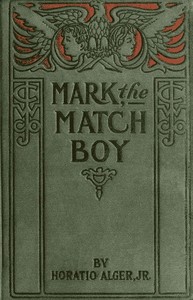
The catalog record for Mark the Match Boy; or, Richard Hunter's Ward — Story, Setting & Ideas provides practical reading context through 52,009 words, 3 hr 47 min estimated reading time, and 33 detected text sections.
The text analysis averages about 12.3 words per sentence, while the detected sections provide another way to judge how the source is divided.
Project Gutenberg metadata also associates the work with “Orphans -- Juvenile fiction,” connecting these edition facts with the source record’s subject description.
Explore this collection
These alternatives are selected using recorded categories and estimated reading time.
About 227 minutes
Fantasy Juvenile Worlds
52,173 recorded words. 0 minutes difference from this book's estimate.
View Gutenberg source #46188About 222 minutes
Fantasy Juvenile Worlds
50,945 recorded words. 5 minutes difference from this book's estimate.
View Gutenberg source #43806About 233 minutes
Fantasy Juvenile Worlds
53,382 recorded words. 6 minutes difference from this book's estimate.
View Gutenberg source #52194Search stored excerpts and compare books → Choose by your preferences →
Choices use stored catalog measurements. Estimates vary with reading speed. A shared category is a catalog label, not a claim that two books have the same argument or literary quality.
Search reads excerpt text stored with this catalog and links to its associated Gutenberg record. The connection is stored in the site database; this tool does not recheck that every excerpt is word-for-word identical to that external record. Excerpt search does not cover every chapter and does not verify historical publication dates.
Catalog snapshot checked: 2026-09-25. Coverage: 96 public books, 96 available source excerpts.
Read the complete public-domain text at its original source.
Read on Project GutenbergAlger opens with a preface that positions this third Ragged Dick volume as both a standalone story and a continuation for readers curious about earlier characters. The narrative voice is direct and instructional, with Richard Hunter—now a bookkeeper—serving as a model of self-improvement. His dialogue with Mark is laced with practical advice: study, save money, and seek honest work. The prose moves briskly between scenes of Mark's recovery, his visit to the Newsboys' Lodge, and his reunion with bootblack Ben Gibson, whose dialect and professional greeting (“Shine yer boots!”) provide a contrasting streetwise register.
The dialogue carries the story’s weight. Richard speaks in measured, instructive sentences: “Take my advice, Mark, and study all you can, and you’ll grow up respectable and respected.” Mark replies with earnest deference, calling Richard “a fine scholar.” Ben Gibson, by contrast, uses colloquial contractions and a professional pitch: “My eyes, if it aint Mark, the match boy!” Alger alternates between these registers to mark social standing and aspiration. The narrator’s own voice is plain and omniscient, rarely lingering on interior states. When Mark feels gratitude, it is stated simply: “You have been very kind to me, Mr. Hunter.”
The plot advances through a series of short, goal-oriented scenes: Mark receives new clothes, visits the Lodge to withdraw savings, and seeks out Ben. Each episode ends with a clear outcome—a transaction, a promise, or a reunion. Alger uses the rhythm of errands to create momentum. The superintendent’s brief appearance at the Lodge serves as a checkpoint, confirming Richard’s good reputation. The pace slows only for didactic exchanges, such as Richard’s account of his own illiteracy at fourteen. These pauses reinforce the book’s instructional purpose without halting the forward movement.
New York is sketched through functional locations: the boarding-house, the Newsboys’ Lodge, Nassau Street. Alger names streets (Fulton, Spruce) to ground the action in a recognizable geography. The Lodge is a place of order, where the superintendent knows boys by name and keeps their savings. Nassau Street is Ben’s workplace, a public stage for his trade. The contrast between these settings—indoor refuge versus street commerce—mirrors Mark’s transition from match boy to ward. The city itself is neither romanticized nor condemned; it is a backdrop for transactions of kindness and labor.
Readers attentive to voice will notice how Alger uses repetition—of phrases like “good boy” and “kind friends”—to reinforce moral categories. The excerpts offer no complete plot, but the pattern of rescue, advice, and return to the streets suggests a cyclical structure common to the series. Pay attention to how Alger manages the tension between Mark’s independence and his dependence on Richard, a dynamic that drives the narrative forward.
It’s funny how some books stay with you, like a quiet echo. Mark’s gratitude in Mark the Match Boy felt so real, that ache to belong. I think the same gentle warmth is in Who Was Paul Grayson? — Reading Notes, that same feeling of watching someone figure out who they are. It lingered with me softly.
Capture what you thought, learned, and would like to remember.