About 235 minutes
Running to Waste: The Story of a Tomboy — Text and Context
Fantasy Juvenile Worlds
53,861 recorded words. 2 minutes difference from this book's estimate.
View Gutenberg source #50246
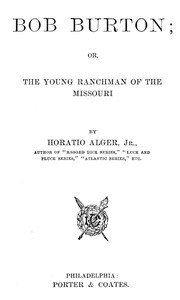
The catalog record for Bob Burton; or, The Young Ranchman of the Missouri — A Reader’s Guide provides practical reading context through 53,382 words, 3 hr 53 min estimated reading time, and 7 detected text sections.
The text analysis averages about 11.2 words per sentence, while the detected sections provide another way to judge how the source is divided.
Project Gutenberg metadata also associates the work with “Conduct of life -- Juvenile fiction,” connecting these edition facts with the source record’s subject description.
Explore this collection
These alternatives are selected using recorded categories and estimated reading time.
About 235 minutes
Fantasy Juvenile Worlds
53,861 recorded words. 2 minutes difference from this book's estimate.
View Gutenberg source #50246About 227 minutes
Fantasy Juvenile Worlds
52,173 recorded words. 6 minutes difference from this book's estimate.
View Gutenberg source #46188About 227 minutes
Fantasy Juvenile Worlds
52,009 recorded words. 6 minutes difference from this book's estimate.
View Gutenberg source #53071Search stored excerpts and compare books → Choose by your preferences →
Choices use stored catalog measurements. Estimates vary with reading speed. A shared category is a catalog label, not a claim that two books have the same argument or literary quality.
Search reads excerpt text stored with this catalog and links to its associated Gutenberg record. The connection is stored in the site database; this tool does not recheck that every excerpt is word-for-word identical to that external record. Excerpt search does not cover every chapter and does not verify historical publication dates.
Catalog snapshot checked: 2026-09-25. Coverage: 96 public books, 96 available source excerpts.
Read the complete public-domain text at its original source.
Read on Project GutenbergHoratio Alger’s Bob Burton; or, The Young Ranchman of the Missouri opens with a telling exchange: Clip, a formerly enslaved boy, repeatedly calls his employer “massa,” despite being corrected. This small verbal habit signals the novel’s interest in lingering hierarchies and the difficulty of shedding old identities. The story moves between two primary landscapes—the Burton ranch and the Missouri River—and each shift in setting brings a new set of challenges, from stolen receipts to hidden passengers. The narrative is built around a series of discrete episodes, often involving concealment, pursuit, or sudden departure, rather than a single sustained plot.
The novel’s chapter titles read like a sequence of set pieces: “Aaron Wolverton Steals the Receipt,” “Wolverton’s Adventure with Clip,” “What Bob Found in the Creek,” “The Passenger Discovered.” Each chapter tends to introduce a new complication or a shift in location, and the river functions as both a physical route and a narrative device that enables these transitions. The ferry-boat that Bob buys becomes a mobile stage for encounters—with Sam Wolverton fleeing his uncle, with suspicious characters, and with the threat of discovery. The river’s current propels the story forward, but it also provides opportunities for hiding, as when Sam conceals himself on the boat. This episodic rhythm, with its repeated pattern of departure, concealment, and revelation, gives the novel a picaresque quality, even as it maintains a clear moral framework.
Throughout the excerpts, characters are frequently hidden, discovered, or in the act of concealing themselves. Clip hides his past as a fugitive from Arkansas; Sam Wolverton hides on the ferry-boat to escape his uncle; Aaron Wolverton schemes in secret. The novel’s visual language emphasizes contrast—Clip’s “coal-black skin” and “preturnaturally white” teeth, the blood on Sam’s cheek, the “glorious morning” that Bob takes as an omen. These details create a world where surfaces are deceptive and where the act of seeing or being seen carries weight. The repeated motif of the “lost receipt” and the “secret mission” reinforces a sense that information is always partially hidden, and that the story’s progress depends on uncovering what has been concealed.
The ranch and the river represent two different orders of experience. On the ranch, characters are bound by domestic routines and hierarchies—Clip is a servant, Bob a son, Wolverton a neighbor. The river, by contrast, offers a space of relative freedom and risk. Bob’s decision to buy the ferry-boat and undertake a trip to St. Louis is a move away from the fixed world of the ranch into a more fluid environment where alliances shift and new dangers arise. The novel’s structure mirrors this movement: early chapters are set on the ranch, with conflicts centered on property and inheritance; later chapters follow the river journey, where the stakes become physical survival and escape from captivity. The return to the ranch in the final chapters suggests a resolution that re-establishes domestic order, but the journey itself remains the narrative’s core.
Alger uses dialogue to distinguish characters and to dramatize power imbalances. Clip’s dialect—“What fo’, Massa Bob?”—marks him as both comic and vulnerable, while Bob’s teasing responses (“Your arguments are so cogent, Clip”) show his superior education and social position. Aaron Wolverton’s speech is never directly quoted in the excerpts, but his actions—stealing a receipt, striking his nephew—are reported, and his villainy is conveyed through the reactions of others. Sam’s plea to Bob—“Let me go with you to St. Louis”—is a moment of direct emotional appeal that shifts the balance of the story. These exchanges are not merely expository; they reveal the characters’ relative status and their strategies for negotiation, from Clip’s playful pleading to Sam’s desperate request.
Readers attentive to structure will notice how Alger builds each chapter around a single incident, often ending with a revelation or a decision that propels the next episode. The river journey, in particular, functions as a series of tests—of Bob’s resourcefulness, Clip’s loyalty, and Sam’s courage. The novel rewards close attention to its recurring patterns of hiding and discovery, and to the way its settings—ranch, river, and city—shape the characters’ choices. These patterns, rather than any single plot twist, give the book its distinctive rhythm.
I have often thought, shelving these old companions side by side, that Bob Burton’s restless river holds a quiet kinship with the mechanic’s patient toolbench. Both boys learn that a life is not fixed, but cobbled together—one from drifting logs and hidden cargo, the other from Plane and Plank; or, The Mishaps of a Mechanic — A Reader’s Guide and the steady rhythm of repair. Resourcefulness, I find, is just another word for remembering to breathe.
Use these questions to collect your thoughts before moving on.