About 233 minutes
Bob Burton; or, The Young Ranchman of the Missouri — A Reader’s Guide
Fantasy Juvenile Worlds
53,382 recorded words. 2 minutes difference from this book's estimate.
View Gutenberg source #52194
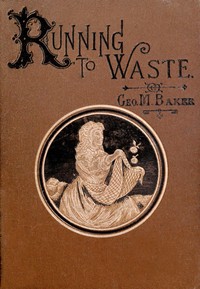
The catalog record for Running to Waste: The Story of a Tomboy — Text and Context provides practical reading context through 53,861 words, 3 hr 55 min estimated reading time, and 26 detected text sections.
The text analysis averages about 14.3 words per sentence, while the detected sections provide another way to judge how the source is divided.
Project Gutenberg metadata also associates the work with “Conduct of life -- Juvenile fiction,” connecting these edition facts with the source record’s subject description.
Explore this collection
These alternatives are selected using recorded categories and estimated reading time.
About 233 minutes
Fantasy Juvenile Worlds
53,382 recorded words. 2 minutes difference from this book's estimate.
View Gutenberg source #52194About 240 minutes
Fantasy Juvenile Worlds
55,190 recorded words. 5 minutes difference from this book's estimate.
View Gutenberg source #53821About 243 minutes
Fantasy Juvenile Worlds
55,883 recorded words. 8 minutes difference from this book's estimate.
View Gutenberg source #44808Search stored excerpts and compare books → Choose by your preferences →
Choices use stored catalog measurements. Estimates vary with reading speed. A shared category is a catalog label, not a claim that two books have the same argument or literary quality.
Search reads excerpt text stored with this catalog and links to its associated Gutenberg record. The connection is stored in the site database; this tool does not recheck that every excerpt is word-for-word identical to that external record. Excerpt search does not cover every chapter and does not verify historical publication dates.
Catalog snapshot checked: 2026-09-25. Coverage: 96 public books, 96 available source excerpts.
Read the complete public-domain text at its original source.
Read on Project GutenbergFrom the opening line—"Bouncers, Teddy! the roundest and the rosiest"—George M. Baker establishes a voice that is immediate, colloquial, and full of physical energy. The dialogue between Becky Sleeper and her brother Teddy drives the first chapter, with short, exclamatory sentences that mimic the breathlessness of their apple-stealing adventure. Baker's narrative voice shifts between this lively speech and a more formal, moralizing commentary, creating a deliberate contrast that signals the book's dual interest in adventure and instruction.
The excerpts show that Baker relies heavily on dialogue to advance action and reveal character. Becky's commands—"Drop them, quick!"—and Teddy's protests—"It's very well to say drop them"—create a rhythm of call and response that feels theatrical. This is consistent with Baker's background as a playwright (author of "Amateur Dramas" and "Drawing-Room Stage"). The dialogue is peppered with period slang like "by a long chalk" and "bully for you," giving the speech a regional flavor. Notably, the dialogue often carries the plot: Teddy's cry of "Fire! fire! fire!" triggers the entire engine-house episode, and the subsequent exchange with Phil Hague—"Bedad, its foine kindlings"—adds comic relief through dialect. The pacing accelerates during these exchanges, with short lines and minimal narration, before slowing for descriptive passages.
Baker modulates pace by alternating between rapid-fire dialogue and slower, more reflective narration. The opening scene moves quickly, with Becky perched on a wall and apples falling into her apron. But after the theft, the narrative pauses to describe Teddy's "rotundity of form and cool, phlegmatic disposition" in a more measured, almost essayistic tone. The fire episode demonstrates a similar pattern: the rush to the engine house, the comic tumble of the "Cataract" down the hill, and then a deflation when the machine fails. Baker uses the crowd's laugh and Teddy's "very red face" to mark a shift from action to embarrassment. These changes in tempo mirror the book's thematic concern with the consequences of impulsive behavior, as Becky's "frolics" give way to moments of reflection or setback.
The catalog lists Maine as a subject, and the excerpts ground the story in a specific rural landscape: an orchard wall, a paper mill, a church, an engine house. Baker's descriptive voice is economical—"the wall was the boundary of Captain Thompson's orchard"—but he uses setting to reinforce mood. The fire scene is anchored by concrete details: "smoke rolling up over the paper mill," the engine "not much larger than a good-sized wash-tub." The characters' speech reflects this environment; Phil Hague's Irish brogue and Teddy's plainspokenness contrast with the narrator's more formal register. This layering of voices—Becky's boldness, Teddy's phlegm, Phil's blarney—creates a social texture that feels particular to a small Maine town. The setting is not merely backdrop but an active element in the plot, as when the hill's slope turns the engine into a runaway hazard.
Readers attentive to language will notice how Baker uses dialect not just for color but to differentiate characters and signal social standing. The shifts between high-spirited action and moral commentary are worth tracking, as they reveal the book's didactic undercurrent. Because the excerpts are incomplete, the full arc of Becky's transformation remains unclear, but the early chapters establish a pattern of mischief followed by consequence that likely structures the whole.
That rainy afternoon, the editorial notes on Baker’s tomboy reminded me how quiet lessons often hide inside boisterous play. I found myself drifting to the gentler world of the Little Peppers, where Polly’s stories carry the same warmth. It felt less like a choice and more like the rain turning to The Stories Polly Pepper Told to the Five Little Peppers in the Little Brown House — Reading Companion, a softer echo of the same old truth.
Create a short personal record of your experience with this book.