About 171 minutes
Connie Carl at Rainbow Ranch — Themes and Context
Fantasy Juvenile Worlds
39,251 recorded words. 4 minutes difference from this book's estimate.
View Gutenberg source #45452
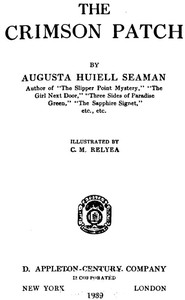
The catalog record for The Crimson Patch — Edition Insights provides practical reading context through 40,220 words, 2 hr 55 min estimated reading time, and 19 detected text sections.
The text analysis averages about 14.8 words per sentence, while the detected sections provide another way to judge how the source is divided.
Project Gutenberg metadata also associates the work with “Friendship -- Juvenile fiction,” connecting these edition facts with the source record’s subject description.
Explore this collection
These alternatives are selected using recorded categories and estimated reading time.
About 171 minutes
Fantasy Juvenile Worlds
39,251 recorded words. 4 minutes difference from this book's estimate.
View Gutenberg source #45452About 157 minutes
Fantasy Juvenile Worlds
36,095 recorded words. 18 minutes difference from this book's estimate.
View Gutenberg source #46317About 153 minutes
Fantasy Juvenile Worlds
34,982 recorded words. 22 minutes difference from this book's estimate.
View Gutenberg source #45975Search stored excerpts and compare books → Choose by your preferences →
Choices use stored catalog measurements. Estimates vary with reading speed. A shared category is a catalog label, not a claim that two books have the same argument or literary quality.
Search reads excerpt text stored with this catalog and links to its associated Gutenberg record. The connection is stored in the site database; this tool does not recheck that every excerpt is word-for-word identical to that external record. Excerpt search does not cover every chapter and does not verify historical publication dates.
Catalog snapshot checked: 2026-09-25. Coverage: 96 public books, 96 available source excerpts.
Read the complete public-domain text at its original source.
Read on Project GutenbergPatricia Meade arrives at a hotel bedroom with 'stiff-looking twin brass beds' and immediately begins unpacking to make the space feel 'careless and cosy.' Her father, Captain Meade, is in uniform, and a bell-boy gazes 'adoringly' at the khaki. The story quickly introduces a missing sketch of a butterfly—'the one called the Crimson Patch'—which Patricia believes was taken during a visit from Virginie and Peter Stoger. A tense phone call follows: Virginie whispers a warning about danger, then hangs up abruptly. The opening establishes a setting of domestic discomfort and escalating mystery, with the hotel as a stage for suspicion.
The hotel suite—Suite Number 403—is described in precise, unadorned detail: 'twin brass beds, two willow rockers, one straight chair, an imposing mahogany bureau.' Patricia’s immediate impulse to scatter belongings for a 'cosy' feel contrasts with the sterile, monitored environment. The setting is not just a backdrop but a pressure chamber. Characters enter and exit: the bell-boy, Peter Stoger, Virginie. Each visit leaves a trace of unease. The missing sketch is not merely a lost object; it becomes a focal point for distrust. Patricia’s father is 'frantic' about it, and the search pulls in everyone who was present. The hotel’s public-private nature—rooms with thin walls, telephones that ring with cryptic messages—amplifies the sense that no conversation is truly secure.
Patricia’s friendship with Virginie is built on trust that is tested by silence. When Patricia insists, 'I will never, never believe such a thing of her!' about Virginie’s possible involvement, the repetition underscores her desperation. Virginie’s phone call is marked by hesitation: 'she spoke so low, and she hesitated so.' The incomplete message—'You want to warn me.... What about? I don't understand'—leaves Patricia and the reader in the dark. Chester, the boy, interprets the call as a sign that Virginie was 'speakin' to you over the 'phone on the q.t., an' she was probably scared stiff.' The dialogue is clipped, full of ellipses and interruptions, mirroring the fractured communication under threat. The friendship is defined by what cannot be said.
The narrative relies on close observation and deduction. Chester reconstructs the timeline of the theft: 'It didn't disappear before I come in, so the responsible party must have come afterward.' He narrows suspects to Peter Stoger, reasoning that if Peter is 'Franz,' he would send a note and then 'they all beat it out of here.' Patricia and Chester piece together events from small clues—a telephone click, a voice that sounds 'faraway and scared.' The story does not reveal motives or outcomes in the excerpts; instead, it presents a chain of inferences. Readers are invited to watch the characters watch each other. The repeated phrase 'You can search me!' from Chester signals the limits of their knowledge. The mystery deepens not through action but through the accumulation of uncertain details.
The excerpts offer a tightly wound puzzle set in a confined space. Pay attention to how objects—the sketch, the telephone, the hotel room—function as triggers for suspicion. The dialogue is layered with subtext; characters often say less than they mean. The incomplete phone call and the missing sketch are not resolved in the provided text, so the reader must track each character’s movements and statements carefully. The story rewards attention to timing and placement.
There’s something about The Crimson Patch’s hushed hotel corridors and half-told secrets that reminds me of quieter afternoons spent with Elsie's Young Folks in Peace and War — Story, Setting & Ideas. War touches both, but never loudly—just in the way rooms feel emptier, and goodbyes linger a breath too long. I still think about that butterfly sketch sometimes.
A brief reflection can help important ideas stay with you longer.