About 200 minutes
Little Lord Fauntleroy [abridged]: Für den Schulgebrauch bearbeitet — Text and Context
Fantasy Juvenile Worlds
45,859 recorded words. 6 minutes difference from this book's estimate.
View Gutenberg source #49579
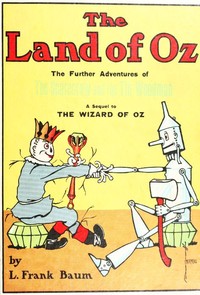
The Land of Oz — Key Ideas to Explore can be approached with a clearer sense of reading commitment from its source measurements: 47,346 words, 3 hr 26 min estimated reading time, and 8 detected text sections.
The text analysis averages about 17.2 words per sentence, while the detected sections provide another way to judge how the source is divided.
Project Gutenberg metadata also associates the work with “Oz (Imaginary place) -- Juvenile fiction,” connecting these edition facts with the source record’s subject description.
Explore this collection
These alternatives are selected using recorded categories and estimated reading time.
About 200 minutes
Fantasy Juvenile Worlds
45,859 recorded words. 6 minutes difference from this book's estimate.
View Gutenberg source #49579About 200 minutes
Fantasy Juvenile Worlds
45,829 recorded words. 6 minutes difference from this book's estimate.
View Gutenberg source #55080About 198 minutes
Fantasy Juvenile Worlds
45,394 recorded words. 8 minutes difference from this book's estimate.
View Gutenberg source #50471Search stored excerpts and compare books → Choose by your preferences →
Choices use stored catalog measurements. Estimates vary with reading speed. A shared category is a catalog label, not a claim that two books have the same argument or literary quality.
Search reads excerpt text stored with this catalog and links to its associated Gutenberg record. The connection is stored in the site database; this tool does not recheck that every excerpt is word-for-word identical to that external record. Excerpt search does not cover every chapter and does not verify historical publication dates.
Catalog snapshot checked: 2026-09-25. Coverage: 96 public books, 96 available source excerpts.
Read the complete public-domain text at its original source.
Read on Project GutenbergBaum opens The Land of Oz not with Dorothy but with Tip, a boy living with the witch Mombi, who threatens to turn him into a marble statue. Tip's first act of creation—carving a pumpkin head and using Mombi's own Powder of Life to animate it—sets the pattern for the book: characters invent their own companions, and magic is a practical, often comical tool. The author's note reveals that this sequel was written in response to thousands of child readers demanding more of the Scarecrow and Tin Woodman, and the text itself rewards that demand by making those characters central to the plot.
The opening chapters establish a world where creation is casual and consequences are immediate. Tip carves a pumpkin head, mounts it on a sawhorse body, and brings it to life with a powder stolen from Mombi. The resulting creature, Jack Pumpkinhead, is not horrified by his own existence but simply asks, “What is my name?” This matter-of-fact acceptance of the miraculous is typical of Oz. The Powder of Life itself is a substance, not a spell—Baum treats magic as a technology that can be used by anyone who knows the recipe. Tip's experiment is not an accident but a deliberate act of defiance, and it immediately forces him to flee, setting the entire plot in motion.
When Tip and Jack reach the Emerald City, they find it under new management. General Jinjur has led an army of girls armed with knitting-needles to overthrow the Scarecrow, who was king. The Scarecrow's response is characteristic: he does not fight but instead plans an escape, reasoning that “a live Scarecrow is better than a dead one.” His wisdom is practical and self-deprecating. The revolt itself is treated as both absurd and serious—the girls are efficient soldiers, but their weapons are domestic tools. Baum uses the situation to poke gentle fun at gender roles without making a heavy statement. The Scarecrow's escape, aided by a saw-horse brought to life, becomes a chase sequence that showcases the book's blend of peril and comedy.
As the fugitives travel to seek help from the Tin Woodman, Mombi pursues them with illusions. The excerpts show a series of obstacles—a river, a wall, a whirl of forty roads, and a sheet of flame—that are all revealed to be deceptions. The Queen of the Field Mice leads them safely through each one, walking calmly through fire that the Scarecrow fears will burn his straw. The Woggle-Bug, a highly magnified insect who joins the party, comments that this “upsets all the Natural Laws.” The Scarecrow replies that magic is unnatural and therefore to be feared and avoided. This exchange is typical of Baum's method: he presents magical events as real within the story but allows characters to comment on their strangeness, keeping the tone light and thoughtful.
When the party finally reaches the Tin Woodman, they find him ruling the Winkies as a “Nickel-Plated Emperor.” His palace is described in terms of polished metal and mechanical precision. The Tin Woodman's character is defined by his gentleness and his fear of rust, but in the excerpts he shows no hesitation when confronting the guards at the Emerald City gate. He swings his axe “in a great circle” and advances, knowing that at worst the knitting-needles can only scratch his nickel plate. This combination of vulnerability and bravery is central to his appeal. Baum's prose here is brisk and visual, emphasizing action over description. The Tin Woodman's role in the story is to provide both muscle and moral support, and his interactions with the Scarecrow and Jack Pumpkinhead create a trio of friends who complement each other's strengths and weaknesses.
Readers coming to The Land of Oz after The Wonderful Wizard of Oz will find a similar structure—a journey, a group of odd companions, and a series of magical tests—but the tone is more playful and the magic more whimsical. Baum's decision to begin with a new protagonist, Tip, rather than Dorothy, signals that Oz is a place of endless possibilities, not dependent on any single hero. Pay attention to how each character's limitations (straw, tin, pumpkin, wood) become sources of both humor and problem-solving. The book rewards careful reading of its small details, like the Powder of Life or the Wishing Pills, which may reappear in unexpected ways.
That rainy afternoon, buried in The Land of Oz, I kept thinking how casually its characters accept each twist—a pumpkin head, a whipping army—as simply business. Oddly, that matter-of-factness reminded me of an older story’s gentle resignation, where a crippled prince’s magic cloak likewise solves nothing grandly, just carries him along. So I found myself wandering into The Little Lame Prince and His Travelling Cloak — Text and Context, and the afternoon quietly stretched on.
Capture what you thought, learned, and would like to remember.